The length of a potentiometer wire is $l$. $A$ cell of $\mathrm{emf}$ $E$ is balanced at a length $l/3$ from the positive end of the wire. If the length of the wire is increased by $l/2$. At what distance will the same cell give a balance point.
Diffcult
Download our app for free and get started
Let $x$ be the desired length.
Potential gradient in the first case $=\frac{E_{0}}{l}$
$E=\left(\frac{l}{3}\right) \cdot\left(\frac{E_{0}}{l}\right)=\frac{E_{0}}{3}….(\mathrm{i})$
Potential gradient in the second case.
$=\frac{E_{0}}{3 l / 2}=\frac{2 E_{0}}{3 l}$
$\therefore E=(x) \frac{2 E_{0}}{3 l}$$...(II)$
From equations $(i)$ and $(ii),$ we get
$\frac{E_{0}}{3}=\left(\frac{2 E_{0}}{3 l}\right) x$
$\Rightarrow x=\frac{1}{2}$

Download our appand get started for free
Experience the future of education. Simply download our apps or reach out to us for more information. Let's shape the future of learning together!No signup needed.*
Similar Questions
- 1The resistivity of alloys $ = {R_{{\rm{alloy}}}}$; the resistivity of constituent metals ${R_{{\rm{metal}}}}$. Then, usuallyView Solution
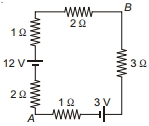
- 2Potential difference $V_B-V_A$ in the network shown is ............. $V$View Solution
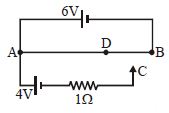
- 3A $6\, volt$ battery of negligible internal resistance resistance is connected across a uniform wire $AB$ of length $100\,cm$. The positive terminal of another battery of $emf$ $4\,V$ and internal resistance $1\,\Omega $ is joined to the point $A$ as shown in fig. Take the potential at $B$ to be zero. At which point $D$ of the wire $AB$, from left the potential is equal to the potential at $C$ ? ...................... $cm$ (approximately)View Solution
- 4A wire of length $L$ and $3$ identical cells of negligible internal resistances are connected in series. Due to current, the temperature of the wire is raised by $\Delta T$ in a time $t$. A number $N$ of similar cells is now connected in series with a wire of the same material and cross-section but of length $2\, L$. The temperature of the wire is raised by the same amount $\Delta T$ in the same time $t$. the value of $N$ isView Solution
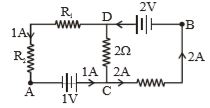
- 5In the circuit shown below, if the potential at point $A$ is taken to be zero, the potential at point $B$ is .............. $V$View Solution
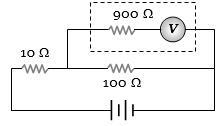
- 6The potential difference across the $100\,\Omega$ resistance in the following circuit is measured by a voltmeter of $900 \,\Omega$ resistance. The percentage error made in reading the potential difference isView Solution
- 7If a copper wire is stretched to increase its length by $20 \% $. The percentage increase in resistance of the wire is $..........\%$View Solution
- 8The current in the following circuit is ........... $A$View Solution
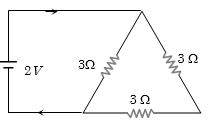
- 9Equal potentials are applied on an iron and copper wire of same length. In order to have the same current flow in the two wires, the ratio $r$ (iron)/$r$ (copper) of their radii must be (Given that specific resistance of iron = $1.0 \times {10^{ - 7}}$ $ ohm-m$ and specific resistance of copper = $1.7 \times {10^{ - 8}}\,ohm-m$)View Solution
- 10In a potentiometer arrangement. $E_1$ is the cell establishing current in primary circuit. $E_2$ is the cell to be measured. $AB$ is the potentiometer wire and $G$ is a galvanometer. Which of the following are the essential condition for balance to be obtained.View Solution