The length of a seconds pendulum is .... $cm$
Easy
Download our app for free and get started
(b )$T = 2\pi \sqrt {l/g} $
$\Rightarrow l = \frac{{g{T^2}}}{{4{\pi ^2}}} = \frac{{9.8 \times 4}}{{4 \times {\pi ^2}}} = 99\;cm$

Download our appand get started for free
Experience the future of education. Simply download our apps or reach out to us for more information. Let's shape the future of learning together!No signup needed.*
Similar Questions
- 1A simple pendulum has time period 't'. Its time period in a lift which is moving upwards with acceleration $3 ms ^{-2}$ isView Solution
- 2The amplitude of a damped oscillator becomes one third in $2\, sec$. If its amplitude after $6\, sec$ is $1/n$ times the original amplitude then the value of $n$ isView Solution
- 3For a particle executing $S.H.M.,\, x =$ displacement from equilibrium position, $v =$ velocity at any instant and $a =$ acceleration at any instant, thenView Solution
- 4The angular frequency of motion whose equation is $4\frac{{{d^2}y}}{{d{t^2}}} + 9y = 0$ is ($y =$ displacement and $t =$ time)View Solution
- 5A block of mass $200\, g$ executing $SHM$ under the influence of a spring of spring constant $K=90\, N\,m^{-1}$ and a damping constant $b=40\, g\,s^{-1}$. The time elapsed for its amplitude to drop to half of its initial value is ...... $s$ (Given $ln\,\frac{1}{2} = -0.693$)View Solution
- 6The potential energy of a particle of mass $4\,kg$ in motion along the $x$-axis is given by $U =4(1-\cos 4 x )\,J$. The time period of the particle for small oscillation $(\sin \theta \simeq \theta)$ is $\left(\frac{\pi}{ K }\right)\,s$. The value of $K$ is .......View Solution
- 7Time period of a simple pendulum in a stationary lift is ' $T$ '. If the lift accelerates with $\frac{ g }{6}$ vertically upwards then the time period will be .....View Solution
(where $g =$ acceleration due to gravity)
- 8View SolutionA system is oscillating with undamped simple harmonic motion. Then the
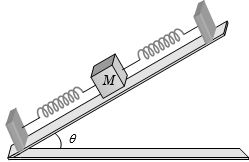
- 9On a smooth inclined plane, a body of mass $M$ is attached between two springs. The other ends of the springs are fixed to firm supports. If each spring has force constant $K$, the period of oscillation of the body (assuming the springs as massless) isView Solution
- 10View SolutionThe total energy of a particle executing simple harmonic motion is