The length of a spring is $l$ and its force constant is $k$. When a weight $W$ is suspended from it, its length increases by $x$. If the spring is cut into two equal parts and put in parallel and the same weight $W$ is suspended from them, then the extension will be
Easy
Download our app for free and get started
(d) Spring is cut into two equal halves so spring constant of each part $= 2k$
These parts are in parallel so ${K_{eq}} = 2K + 2K = 4K$
Extension force (i.e. $W$) is same hence by using $F = kx$
These parts are in parallel so ${K_{eq}} = 2K + 2K = 4K$
Extension force (i.e. $W$) is same hence by using $F = kx$
==> $4k \times x' = kx$
==> $x' = \frac{x}{4}$.

Download our appand get started for free
Experience the future of education. Simply download our apps or reach out to us for more information. Let's shape the future of learning together!No signup needed.*
Similar Questions
- 1A block of mass $m$ rests on a platform. The platform is given up and down $SHM$ with an amplitude $d$ . What can be the maximum frequency so that the block never leaves the platformView Solution
- 2A cylindrical plastic bottle of negligible mass of filled with $310\, ml$ of water and left floating in a pond with still water. If pressed downward slightly and released, it starts performing simple harmonic motion at angular frequency $\omega $. If the radius of the bottle is $2.5\, cm$ then $\omega $ is close to ..... $rad\, s^{-1}$ (density of water $= 10^3\, kg/m^3$)View Solution
- 3View SolutionA graph of the square of the velocity against the square of the acceleration of a given simple harmonic motion is
- 4The angular velocities of three bodies in simple harmonic motion are ${\omega _1},\,{\omega _2},\,{\omega _3}$ with their respective amplitudes as ${A_1},\,{A_2},\,{A_3}$. If all the three bodies have same mass and velocity, thenView Solution
- 5If the length of a pendulum is made $9$ times and mass of the bob is made $4$ times then the value of time period becomesView Solution
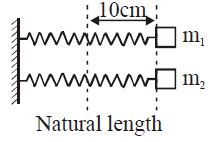
- 6The drawing shows a top view of a frictionless horizontal surface, where there are two indentical springs with particles of mass $m_1$ and $m_2$ attached to them. Each spring has a spring constant of $1200\ N/m.$ The particles are pulled to the right and then released from the positions shown in the drawing. How much time passes before the particles are again side by side for the first time if $m_1 = 3.0\ kg$ and $m_2 = 27 \,kg \,?$View Solution
- 7Displacement between maximum potential energy position and maximum kinetic energy position for a particle executing $S.H.M.$ isView Solution
- 8A particle executing simple harmonic motion has an amplitude of $6\, cm$. Its acceleration at a distance of $2 \,cm$ from the mean position is $8\,cm/{s^2}$. The maximum speed of the particle is ... $ cm/s$View Solution
- 9If $x = a\sin \left( {\omega t + \frac{\pi }{6}} \right)$ and $x' = a\cos \omega t$, then what is the phase difference between the two wavesView Solution
- 10A particle executes simple hormonic motion between $x =\, -A$ and $x = +A$ . It starts from $x = 0$ moves in $+x-$ direction. The time taken for it to move from $x = 0$ to $x = \frac {A}{2}$ is $T_1$ and to move from $\frac {A}{2}$ to $\frac {A}{\sqrt 2}$ is $T_2$ , thenView Solution