If $x = a\sin \left( {\omega t + \frac{\pi }{6}} \right)$ and $x' = a\cos \omega t$, then what is the phase difference between the two waves
Medium
Download our app for free and get started
(a) $x = a\sin \left( {\omega t + \frac{\pi }{6}} \right)$ and $x' = a\cos \omega t = a\sin \,\left( {\omega \,t + \frac{\pi }{2}} \right)$
$\therefore \Delta \phi = \left( {\omega t + \frac{\pi }{2}} \right) - \left( {\omega t + \frac{\pi }{6}} \right) = \frac{\pi }{3}$
$\therefore \Delta \phi = \left( {\omega t + \frac{\pi }{2}} \right) - \left( {\omega t + \frac{\pi }{6}} \right) = \frac{\pi }{3}$

Download our appand get started for free
Experience the future of education. Simply download our apps or reach out to us for more information. Let's shape the future of learning together!No signup needed.*
Similar Questions
- 1The angular frequency of the damped oscillator is given by, $\omega = \sqrt {\left( {\frac{k}{m} - \frac{{{r^2}}}{{4{m^2}}}} \right)} $ where $k$ is the spring constant, $m$ is the mass of the oscillator and $r$ is the damping constant. If the ratio $\frac{{{r^2}}}{{mk}}$ is $8\%$, the change in time period compared to the undamped oscillator is approximately as followsView Solution
- 2If a particle under S.H.M. has time period 0.1 sec and amplitude $2 \times 10^{-3}$. It has maximum velocityView Solution
- 3On a planet a freely falling body takes $2 \,sec$ when it is dropped from a height of $8 \,m$, the time period of simple pendulum of length $1\, m$ on that planet is ..... $\sec$View Solution
- 4The length of a seconds pendulum is .... $cm$View Solution
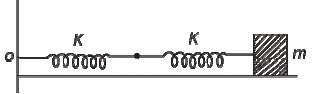
- 5The frequency of oscillations of a mass $m$ connected horizontally by a spring of spring constant $k$ is $4 Hz$. When the spring is replaced by two identical spring as shown in figure. Then the effective frequency is,View Solution
- 6A spring whose unstretched length is $\ell $ has a force constant $k$. The spring is cut into two pieces of unstretched lengths $\ell_1$ and $\ell_2$ where, $\ell_1 = n\ell_2$ and $n$ is an integer. The ratio $k_1/k_2$ of the corresponding force constants, $k_1$ and $k_2$ will beView Solution
- 7The velocity vector $v$ and displacement vector $x$ of a particle executing SHM are related as $\frac{v d v}{d x}=-\omega^2 x$ with the initial condition $v=v_0$ at $x=0$. The velocity $v$, when displacement is $x$, isView Solution
- 8A simple pendulum hanging from the ceiling of a stationary lift has a time period $T_1$. When the lift moves downward with constant velocity, the time period is $T_2$, thenView Solution
- 9The displacement $x$ (in metre) of a particle in, simple harmonic motion is related to time t (in seconds) asView Solution
$x = 0.01\cos \left( {\pi \,t + \frac{\pi }{4}} \right)$
The frequency of the motion will be
- 10Two masses $m_1$ and $m_2$ are supended together by a massless spring of constant $k$. When the masses are in equilibrium, $m_1$ is removed without disturbing the system; the amplitude of vibration isView Solution