MCQ
The magnetic force required to demagnetise the material is:
- ARetentivity.
- BCoercivity.
- CEnergy loss.
- DHysterisis.
Explanation:
Coercivity is the magnetic force required to demagnetise the material.
Generate a complete, print-ready paper with questions like this in minutes — across 16+ boards, with answer keys.
In an electroplating experiment, m gm of silver is deposited when 4 ampere of current flows for 2 minute. The amount (in gm) of silver deposited by 6 ampere of current for 40 second will be
|
(a) 4 m |
(b) m/2 |
(c) m/4 |
(d) 2 m |
The slope of plate characteristic of a vacuum tube diode for certain operating point on the curve is  The plate resistance of the diode and its nature respectively
|
(a) 100 kilo-ohms static |
(b) 1000 kilo-ohms static |
|
(c) 1000 kilo-ohms dynamic |
(d) 100 kilo-ohms dynamic |
Six charges, three positive and three negative of equal magnitude are to be placed at the vertices of a regular hexagon such that the electric field at O is double the electric field when only one positive charge of same magnitude is placed at R. Which of the following arrangements of charges is possible for P, Q, R, S, T and U respectively

|
(a) +, -, +, -, -, + |
(b) +, -, +, -, +, - |
(c) +, +, -, +, -, - |
(d) -, +, +, -, +, - |
The angle of dip at the magnetic equator is
| (a) 0° | (b) 45° | (c) 30° | (d) 90° |
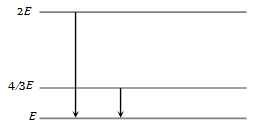
The following diagram indicates the energy levels of a certain atom when the system moves from 2E level to E, a photon of wavelength λ is emitted. The wavelength of photon produced during its transition from  level to E is
|
(a) λ/3 |
(b) 3 λ/4 |
(c) 4 λ/3 |
(d) 3 λ |