MCQ
The mass of an $\alpha$-particle is
  • Less than the sum of masses of two protons and two neutrons
  • B
    Equal to mass of four protons
  • C
    Equal to mass of four neutrons .
  • D
    Equal to sum of masses of two protons and two neutrons

Answer

Correct option: A.
Less than the sum of masses of two protons and two neutrons
a
(a)This is due to mass defect because a part of mass is used in keeping the neutrons and protons bound as $\alpha - $particle.

Need a full question paper?

Generate a complete, print-ready paper with questions like this in minutes — across 16+ boards, with answer keys.
Start Generating Free

Similar questions

$\pi$ mesons can be
A simple pendulum with bob of mass m and conducting wire of length L swings under gravity through an angle 2θ. The earth’s magnetic field component in the direction perpendicular to swing is B. Maximum potential difference induced across the pendulum is

The camera lens has an aperture of $f$ and the exposure time is $(1/60)\,s$. What will be the new exposure time if the aperture become $1.4\,f$ ?
The resolving power of a telescope can be increased by increasing:
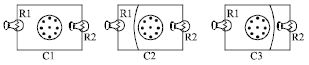
A solenoid is oriented end-on so that its opening is perpendicular to the circuit containing the two light bulbs as drawn in figure $C_1.$ For figure $C_2$ and $C_3,$ a shorting wire of negligible resistance is added as shown. Assume that the magnetic field from the solenoid, shown coming out of the plane of the page, decreases uniformly with time at the same rate for each circuit. Rank the circuits for the brightness of the bulb labeled $R_1$ from brightest to dimmest.
Light of wavelength $1824 Å$, incident on the surface of a metal, produces photo-electrons with maximum energy $5.3 eV.$ When light of wavelength $1216 Å$ is used, the maximum energy of photoelectrons is $8.7 eV$. The work function of the metal surface is .............. $eV$
Biot-Savart law indicates that the moving electrons $($velocity $v)$ produce a magnetic field $B$ such that:
Maximum kinetic energy of the positive ion in the cyclotron is
$AB$ is an object dipped in water at a depth of $d$ . Its length is $l$ . It is seen from air at near normal incidence. The length of the image is
At the centre $(t = 0)$ of Newton's ring arrangement, we observe a: