MCQ
The material suitable for making electromagnets should have:
- AHigh retentivity and high coercivity.
- BLow retentivity and low coercivity.
- CHigh retentivity and low coercivity.
- DLow retentivity and high coercivity.
Explanation:
An electromagnet is necessary for the material that even if the current is turned off, the material losses its magnetic field. So, it should be made from such a material that its retentivity is very high. And there must be enough coercion force for the material which can restore its pre-magnetization state. For that its coercivity should be as minimum as possible.
Generate a complete, print-ready paper with questions like this in minutes — across 16+ boards, with answer keys.
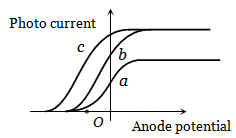
The figure shows the variation of photocurrent with anode potential for a photo-sensitive surface for three different radiations. Let  and
and  be the intensities and
  and
and  be the frequencies for the curves a, b and c respectively
|
(a) |
(b) |
|
(c) |
(d) |
The ratio of the largest to shortest wavelengths in Lyman series of hydrogen spectra is
|
(a) |
(b) |
(c) |
(d) |
Assertion : The induced emf in a conducting loop of wire will be non zero when it rotates in a uniform magnetic field.
Reason : The emf is induced due to change in magnetic flux.
|
(a) If both assertion and reason are true and the reason is the correct explanation of the assertion. |
|
(b) If both assertion and reason are true but reason is not the correct explanation of the assertion. |
|
(c) If assertion is true but reason is false. |
|
(d) If the assertion and reason both are false. |
Consider the situation shown in the figure. The capacitor A has a charge q on it whereas B is uncharged. The charge appearing on the capacitor B a long time after the switch is closed is

|
(a) Zero |
(b) q/2 |
(c) q |
(d) 2q |
An electron is accelerated through a p.d. of 45.5 volt. The velocity acquired by it is (in ms-1)
|
(a) 4 |
(b) 4 |
(c) |
(d) Zero |
If two + 5 D lenses are mounted at some distance apart, the equivalent power will always be negative if the distance is
|
(a) Greater than 40 cm |
(b) Equal to 40 cm |
|
(c) Equal to 10 cm |
(d) Less than 10 cm |
In the lowest energy level of hydrogen atom, the electron has the angular momentum
|
(a) |
(b) h/ |
(c) h/2 |
(d) |
A glass rod rubbed with silk is used to charge a gold leaf electroscope and the leaves are observed to diverge. The electroscope thus charged is exposed to X-rays for a short period. Then
|
(a) The divergence of leaves will not be affected |
|
(b) The leaves will diverge further |
|
(c) The leaves will collapse |
|
(d) The leaves will melt |


