MCQ
The maximum current that flows through a fuse wire before it blows out varies with its radius as $[\ce{SCRA} \ 1998]$
  • A
    $r^{3 / 2}$
  • B
    $r$
  • C
    $r^{2 / 3}$
  • $r^{1 / 2}$

Answer

Correct option: D.
$r^{1 / 2}$
$i=\frac{P}{V}=\frac{50}{250}=0.2 \ \mathrm{amp}$.

Need a full question paper?

Generate a complete, print-ready paper with questions like this in minutes — across 16+ boards, with answer keys.
Start Generating Free

Similar questions

A particle moves under the effect of a force $F=C x$ from $x=0$ to $x=x_1$. The work done in the process is
$X$-rays are produced in $X$-ray tube operating at a given accelerating voltage. The wavelength of the continuous $X$-rays has values from
A star producing light of wavelength $6000 \mathring A$ moves away from the earth with a speed of $5 km / sec$. Due to Doppler effect the shift in wavelength will be $\left(c=3 \times 10^8 m / sec \right)$
The maximum force, in addition to the weight required to pull a wire of $5.0 \mathrm{~cm}$ long from the surface of water at temperature $20\  \mathrm{C}$, is $728$ dynes. The surface tension of water is
For adiabatic process, wrong statement is
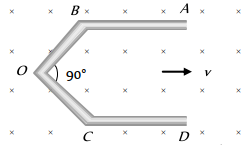
A conductor $A B O C D$ moves along its bisector with a velocity of $1 \mathrm{~m} / \mathrm{s}$ through a perpendicular magnetic field of $1 \mathrm{wb} / \mathrm{m}$, as shown in fig. If all the four sides are of $1 \mathrm{~m}$ length each, then the induced emf between points $A$ and $D$ is

Image
A body of mass $5 \mathrm{~kg}$ moving with a velocity $10 \mathrm{~m} / \mathrm{s}$ collides with another body of the mass $20 \mathrm{~kg}$ at, rest and comes to rest. The velocity of the second body due to collision is
Wave equations of two particles are given by $y_1=a \sin (\omega t-k x)$, $y_2=a \sin (k x+\omega t)$, then
Compton effect is associated with
$100 \mathrm{~mA}$ current gives a full scale deflection in a galvanometer of $2 \Omega$ resistance. The resistance connected with the galvanometer to convert it into a voltmeter to measure $5 \mathrm{~V}$ is