MCQ
$X$-rays are produced in $X$-ray tube operating at a given accelerating voltage. The wavelength of the continuous $X$-rays has values from
  • A
    (a) 0 to $\infty$
  • (b) $\lambda_{\min }$ to $\infty$, where $\lambda_{\min }>0$
  • C
    (c) 0 to $\lambda_{\max }$ where $\lambda_{\max }<\infty$
  • D
    (d) $\lambda_{\min }$ to $\lambda_{\max }$, where $0<\lambda_{\min }<\lambda_{\max }<\infty$
Answer

Correct option: B.
(b) $\lambda_{\min }$ to $\infty$, where $\lambda_{\min }>0$
(b)

Need a full question paper?

Generate a complete, print-ready paper with questions like this in minutes — across 16+ boards, with answer keys.

Start Generating Free

Similar questions

Two bodies of masses $1 \mathrm{~kg}$ and $5 \mathrm{~kg}$ are dropped gently from the top of a tower. At a point $20 \mathrm{~cm}$ from the ground, both the bodies will have the same
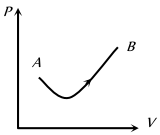
Consider a process shown in the figure. During this process the work done by the system

Image

The Young's modulus of the material of a wire is $6 \times 10^{12} N / m ^2$ and there is no transverse strain in it, then its modulus of rigidity will be
An object $1 \mathrm{~cm}$ tall is placed $4 \mathrm{~cm}$ infront of a mirror. In order to produce an upright image of $3 \mathrm{~cm}$ height one needs a
In the visible region the dispersive powers and the mean angular deviations for crown and flint glass prisms are $\omega, \omega^{\prime}$ and $d, d$ respectively. The condition for getting deviation without dispersion when the two prisms are combined is
When a spring is stretched by $2 \mathrm{~cm}$, it stores $100 \mathrm{~J}$ of energy. If it is stretched further by $2 \mathrm{~cm}$, the stored energy will be increased by
There is a hole in the bottom of tank having water. If total pressure at bottom is $3 atm (1 atm =10 N / m )$ then the velocity of water flowing from hole is
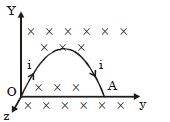
A wire carrying a current $I$ is placed inside a uniform magnetic field $\vec B=-B_0\hat k$. The shape of the wire is parabolic and has equation $Y = 2x -x^2.$ The force on the wire will be :
In Wheatstone's bridge $P=9 \mathrm{ohm}, Q=11 \mathrm{ohm}, R=4 \mathrm{ohm}$ and $S=6 \mathrm{ohm}$. How much resistance must be put in parallel to the resistance $S$ to balance the bridge
If $|\vec{A} \times \vec{B}|=\sqrt{3} \vec{A} \cdot \vec{B}$, then the value of $|\vec{A}+\vec{B}|$ is