Question

The maximum number of possible interference maxima for slit-separation equal to twice the wavelength in Young’s double-slit experiment is

(a) Infinite

(b) Five

(c) Three

(d) Zero

Answer

(b) Five

Need a full question paper?

Generate a complete, print-ready paper with questions like this in minutes — across 16+ boards, with answer keys.

Start Generating Free

Similar questions

An electromagnetic waves can be produced, when charge is:

The mass defect in a particular nuclear reaction is 0.3 grams. The amount of energy liberated in kilowatt hours is (Velocity of light = 3)

(a) 1.5  

(b) 2.5  

(c) 3  

(d) 7.5  

A thin mica sheet of thickness 2  and refractive index μ = 1.5  is introduced in the path of the first wave. The wavelength of the wave used is 5000 Å. The central bright maximum will shift

(a) 2 fringes upward

(b) 2 fringes downward

(c) 10 fringes upward

(d) None of these

Two parallel plates separated by a distance of 5mm are kept at a potential difference of 50 V. A particle  of mass   and charge   enters in it with a velocity .  The acceleration of the particle will be

(a)  

(b)  

(c)

(d) 2 

The refractive index of water and glass with respect to air is 1.3 and 1.5 respectively.  Then the refractive index of glass with respect to water is

(a)  

(b)  

(c)  

(d)  

Faraday's laws of electrolysis are related to

(a) The atomic number of positive ion

(b) The equivalent weight of electrolyte

(c) The atomic number of negative ion

(d) The velocity of positive ion

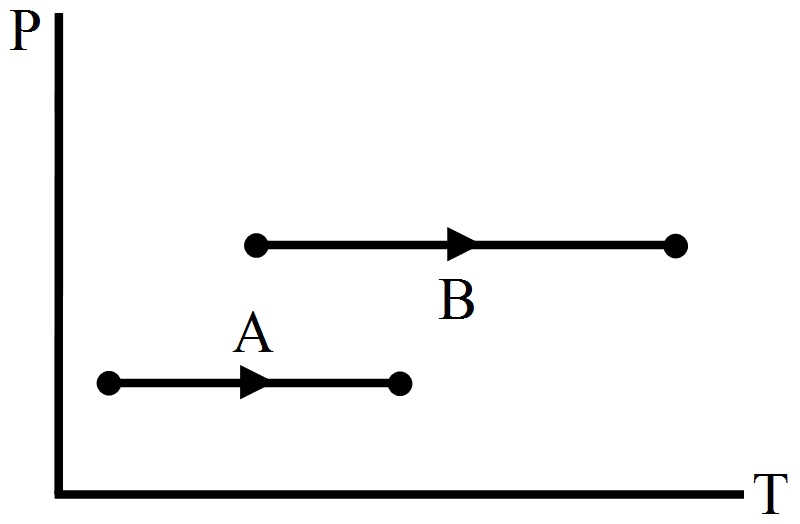
Consider two processes on a system as shown in figure.

The volumes in the initial states are the same in the two processes and the volumes in the final states are also the same. Let $\Delta\text{W}_1$ and $\Delta\text{W}_2$ be the work done by the system in the processes A and B respectively.
  1. $\Delta\text{W}_1>\Delta\text{W}_2.$
  2. $\Delta\text{W}_1=\Delta\text{W}_2.$
  3. $\Delta\text{W}_1<\Delta\text{W}_2.$
  4. Nothing can be said about the relation between $\Delta\text{W}_1$ and $\Delta\text{W}_2.$

In photoelectric effect, the K.E. of electrons emitted from the metal surface depends upon

(a) Intensity of light

(b) Frequency of incident light

(c) Velocity of incident light

(d) Both intensity and velocity of light

The magnetic compass is not useful for navigation near the magnetic poles because

(a) The magnetic field near the poles is zero

(b) The magnetic field near the poles is almost vertical

(c) At low temperature, the compass needle looses its magnetic properties

(d) Neither of the above

Gauss’s law is true for.