MCQ
The mean and variance of a random variable $X$ having a binomial distribution are $4$ and $2$ respectively, then $P(X = 1)$ is
  • $1/32$
  • B
    $1/16$
  • C
    $1/8$
  • D
    $1/4$

Answer

Correct option: A.
$1/32$
a
(a) $\left. {\begin{array}{*{20}{c}}{np = 4}\\{npq = 2}\end{array}} \right\}\, \Rightarrow \,q = \frac{1}{2},\,p = \frac{1}{2},\,n = 8$

$P\,(X = 1) = {\,^8}{C_1}\left( {\frac{1}{2}} \right)\,\,\,{\left( {\frac{1}{2}} \right)^7}$

$ = 8.\,\frac{1}{{{2^8}}} = \frac{1}{{{2^5}}} = \frac{1}{{32}}$.

Need a full question paper?

Generate a complete, print-ready paper with questions like this in minutes — across 16+ boards, with answer keys.
Start Generating Free

Similar questions

Choose the correct answer from the given four options.
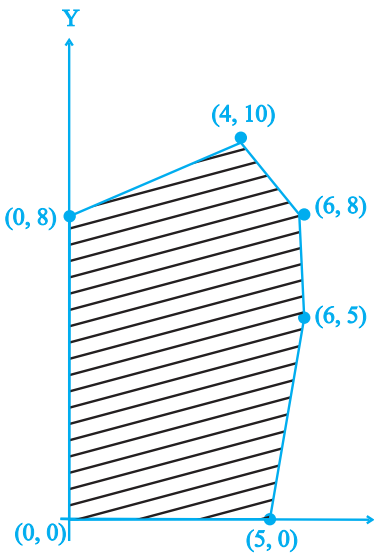
The feasible solution for a LPP is shown in. Let Z = 3x - 4y be the objective function.

Minimum of Z occurs at:
If a cone of maximum volume is inscribed in a given sphere, then the ratio of the height of the cone to the diameter of the sphere is:
  1. $\frac{3}{4}$
  2. $\frac{1}{3}$
  3. $\frac{1}{4}$
  4. $\frac{2}{3}$ 
Let the function, $f:[-7,0] \rightarrow R$ be continuous on $[-7,0]$ and differentiable on $(-7,0)$ If $f(-7)=-3$ and $f(x) \leq 2,$ for all $x \in(-7,0),$ then for all such functions $f, f(-1)+f(0)$ lies in the interval
If $\text{f(x)}=\begin{cases}\text{mx}+1,&\text{x}\leq\frac{\pi}{2}\\\sin\text{x}+\text{n},&\text{n}>\frac{\pi}{2}\end{cases}$ is continuous at $\text{x}=\frac{\pi}{2},$ then:
  1. $\text{m}=1,\text{ n}=0$
  2. $\text{m}=\frac{\text{n}\pi}{2}+1$
  3. $\text{n}=\frac{\text{m}\pi}{2}$
  4. $\text{m}=\text{n}=\frac{\pi}{2}$
A cylindrical tank of radius 10m is being filled with wheat at the rate of 314 cubic metre per hour. Then the depth of the wheat is increasing at the rate of:
  1. $1\text{m}/\text{hr}$
  2. $0.1\text{m}/\text{hr}$
  3. $1.1\text{m}/\text{hr}$
  4. $0.5\text{m}/\text{hr}$
The whole area of the ellipse $\frac{x^2}{25}+\frac{y^2}{16}=1$ is :
The probability that a leap year will have 53 sundays is:
Consider the function $f (x) = x^3 - 8x^2 + 20x -13$
The function $f (x)$ defined for $R \rightarrow R$
The unit normal vector to the line joining $i - j$ and $2\,i + 3\,j$ and pointing towards the origin is
If $I_n =$ $\int\limits_0^1 {\,\,\frac{{dx}}{{{{\left( {1\,\, + \,\,{x^2}} \right)}^n}}}} $; $n \in N$, then which of the following statements hold good ?