MCQ
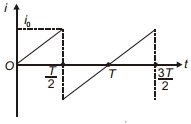
The mean value of current for half cycle for a current variation shown by the graph is
- ✓$\frac{i_0}{2}$
- B$i_0$
- C$\frac{i_0}{\sqrt{3}}$
- D$\frac{i_0}{3}$
$l_{\max }=\frac{\int \limits_0^{T / 2} / d t}{T / 2}$
From 0 to $\frac{T}{2}$ graph is straight line so the function $(l)$ will be $=\frac{i_0}{(T / 2)} t=\frac{2 i_0}{T} t$
$\text { So }$
$l_{\text {mean }}=\frac{2}{T} \int \limits_0^{T / 2} \frac{2 i_0}{T} t d t=\frac{2}{T}\left(\frac{2}{T}\right) i_0\left(\frac{t^2}{2}\right)_0^{T / 2}$
$=\frac{4}{T^2} i_0\left(\frac{1}{2}\right)\left(\frac{T^2}{4}-0\right)=\frac{i_0}{2}$
Generate a complete, print-ready paper with questions like this in minutes — across 16+ boards, with answer keys.
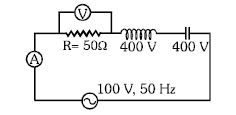
Statement $I :$ Maximum power is dissipated in a circuit containing an inductor, a capacitor and a resistor connected in series with an $AC$ source, when resonance occurs
Statement $II :$ Maximum power is dissipated in a circuit containing pure resistor due to zero phase difference between current and voltage.
In the light of the above statements, choose the correct answer from the options given below :