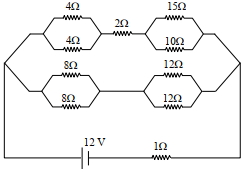
The mechanism of the heat produced in a conductor when an electric current flows through it, can be explained on the basis of
Easy
Download our app for free and get started
Free electron theory:
In metals, most atoms have loosely bound electrons in their outermost orbits, known as free electrons since they have a real nice tendency to detach from their parent atom and move freely. The charge flow occurs due to the movement of electrons. In the presence of an external electric field, all the free electrons would flow in a direction opposite to the field thus constituting a current.
As the electrons move through the metal conductor, some collide with atoms and other electrons or impurities. These collisions cause resistance and generate heat in the conductor.

Download our appand get started for free
Experience the future of education. Simply download our apps or reach out to us for more information. Let's shape the future of learning together!No signup needed.*
Similar Questions
- 1An electric wire of length ‘$I$’ and area of cross-section $a$ has a resistance $R\, ohms$. Another wire of the same material having same length and area of cross-section $4a$ has a resistance ofView Solution
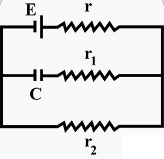
- 2In the given circuit diagram when the current reaches steady state in the circuit, the charge on the capacitor of capacitance $C$ will beView Solution
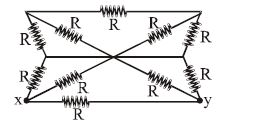
- 3What will be equivalent resistance of circuit between $x$ and $y$View Solution
- 4In a potentiometer experiment, the galvanometer shows no deflection when a cell is connected across $60\, cm$ of the potentiometer wire. If the cell is shunted by a resistance of $6\,\Omega $, the balance is obtained across $50\, cm$ of the wire. The internal resistance of the cell is .............. $\Omega $View Solution
- 5At what temperature will the resistance of a copper wire become three times its value at $0\,^oC$ ................. $^oC$ (Temperature coefficient of resistance for copper = $4 × 10^{-3} \,per\, \,^oC$ )View Solution
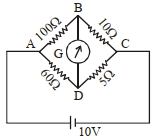
- 6The four arms of a Wheatstone bridge have resistances as shown in the figure. A galvanometer of $15\, \Omega$ resistance is connected across $BD$. Calculate the current through the galvanometer when a potential difference of $10\, V$ is maintained across $AC.$View Solution
- 7View SolutionWhen there is an electric current through a conducting wire along its length, then an electric field must exist
- 8Three equal resistors connected in series across a source of $e.m.f.$ together dissipate $10\, watt$. If the same resistors are connected in parallel across the same $e.m.f.$, then the power dissipated will be .............. $watt$View Solution
- 9In a meter bridge experiment resistances are connected as shown in the figure. Initially resistance $P\, = 4\,\Omega $ and the neutral point $N$ is at $60\,cm$ from $A$. Now an unknown resistance $R$ is connected in series to $P$ and the new position of the neutral point is at $80\,cm$ from $A$ . The value of unknown resistance $R$ isView Solution
- 10The voltage drop across $15\, \Omega$ resistance in the given figure will be $.....V.$View Solution