MCQ
The minimum energy required to eject an electron, from the metal surface is called:
- AAtomic energy.
- BMechanical energy.
- CElectrical energy.
- DWorkfunction.
Generate a complete, print-ready paper with questions like this in minutes — across 16+ boards, with answer keys.
A photon of energy 8 eV is incident on a metal surface of threshold frequency 1.6  , then the maximum kinetic energy of photoelectrons emitted is (h = 6.6
|
(a) 4.8 eV |
(a) 4.8 eV |
(c) 1.4 eV |
(d) 0.8 eV |
The unit of inductance is
|
(a) Volt/ampere |
(b) Joule/ampere |
(c) Volt-sec/ampere |
(d) Volt-ampere/sec |
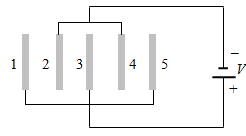
Five identical plates each of area A are joined as shown in the figure. The distance between the plates is d. The plates are connected to a potential difference of V volts. The charge on plates 1 and 4 will be
|
(a) |
(b) |
(c) |
(d) |
The minimum wavelength of X-rays produced in a coolidge tube operated at potential difference of 40 kV is
|
(a) 0.31 Å |
(b) 3.1 Å |
(c) 31 Å |
(d) 311 Å |
As a result of interference of two coherent sources of light, energy is
|
(a) Increased |
|
(b) Redistributed and the distribution does not vary with time |
|
(c) Decreased |
|
(d) Redistributed and the distribution changes with time |
The electron mobility in N-type germanium is 3900 cm2/v-s and its conductivity is 6.24 mho/cm, then impurity concentration will be if the effect of cotters is negligible
|
(a) 1015 cm3 |
(b) 1013 /cm3 |
(c) 1012 /cm3 |
(d) 1016 /cm3 |
A metal rod of length 2 m is rotating with an angular velocity of 100 rad/sec in a plane perpendicular to a uniform magnetic field of 0.3 T. The potential difference between the ends of the rod is
|
(a) 30 V |
(b) 40 V |
(c) 60 V |
(d) 600 V |


