Question
The minimum frequency $\nu $ of continuous $X-$ rays is related to the applied potential difference $V$ as

Answer

(b)$E = h\nu = eV\, \Rightarrow \,\nu \propto V$

Need a full question paper?

Generate a complete, print-ready paper with questions like this in minutes — across 16+ boards, with answer keys.
Start Generating Free

Similar questions

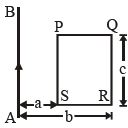
$AB$ is an infinitely long wire placed in the plane of rectangular coil of dimensions as shown in the figure. Calculate the mutual inductance of wire $AB$ and coil $PQRS$
A calorimeter contains $0.2\, kg$ of water at $30\,^oC$, $0.1\,kg$ of water at $60\,^oC$ is added to it, the mixture is well stirred and the resulting temperature is found to be $35\,^oC$. The thermal capacity of calorimeter is .......... $J/K$
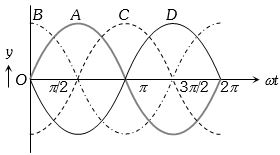
The figure shows four progressive waves $A, B, C$ and $D $ with their phases expressed with respect to the wave $A$. It can be concluded from the figure that
If ${N_P}$and ${N_e}$be the numbers of holes and conduction electrons in an extrinsic semiconductor, then
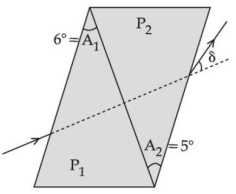
A thin prism of angle $6^{\circ}$ and refractive index for yellow light $\left(n_{Y}\right) 1.5$ is combined with another prism of angle $5^{\circ}$ and $n _{ Y }=1.55$. The combination produces no dispersion. The net average deviation

( $\delta$ ) produced by the combination is $\left(\frac{1}{x}\right)^{\circ}$. The value of $x$ is.......
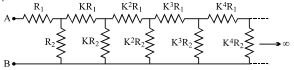
The circuit diagram shown consists of a large number of element (each element has two resistors $R_1$ and $R_2$). The resistance of the resistors in each subsequent element differs by $a$ factor of $K = 1/2$ from the resistance of the resistors in the previous elements. The equivalent reistance between $A$ and $B$ shown in figure is :
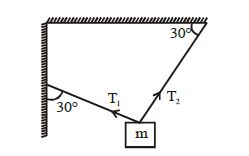
Calculate $T_1$ and $T_2$
An object is placed $20\, cm$ in front of a $4\, cm$ thick plane mirror. The image of the object finally is formed at $45\, cm $ from the object itself . The refractive index of the material of the unpolished side of the mirror is (considering near normal incidence)
Consider the following two statements.                                     

$(A)$ Kirchhoff's junction law follows from the conservation of charge.

 $(B)$ Kirchhoff's loop law follows from the conservation of energy.

Which of the following is correct ?

Which of the following is the most precise device for measuring length