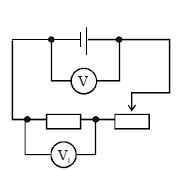
Consider the following two statements.
$(A)$ Kirchhoff's junction law follows from the conservation of charge.
$(B)$ Kirchhoff's loop law follows from the conservation of energy.
Which of the following is correct ?
AIPMT 2010, Easy
Download our app for free and get started
Kirchhoff's junction law or Kirchhoff's first law is based on the conservation of charge. Kirchhoff's loop law or Kirchhoff's second law is based on the conservation of energy.
Hence both statements $(A)$ and $(B)$ are correct.
Hence both statements $(A)$ and $(B)$ are correct.

Download our appand get started for free
Experience the future of education. Simply download our apps or reach out to us for more information. Let's shape the future of learning together!No signup needed.*
Similar Questions
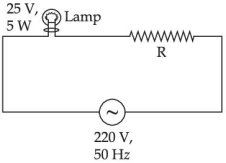
- 1A $220 \; V , 50 \; Hz$ AC source is connected to a $25 \; V$, $5 \; W$ lamp and an additional resistance $R$ in series (as shown in figure) to run the lamp at its peak brightness, then the value of $R$ (in ohm) will beView Solution
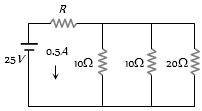
- 2View SolutionIn the circuit as shown in figure the
- 3Resistance $n$, each of $r\; ohm$, when connected in parallel give an equivalentresistance of $R\; ohm$. If these resistances were connected in series, the combination would have a resistance in $ohms$, equal toView Solution
- 4Electric bulb $50\, W$ - $100\, V$ glowing at full power are to be used in parallel with battery $120\, V$, $10 \,\Omega$. Maximum number of bulbs that can be connected so that they glow in full power isView Solution
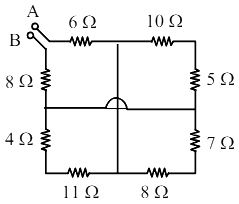
- 5The equivalent resistance between $A$ and $B$ is:View Solution
- 6There is a current of $20$ amperes in a copper wire of ${10^{ - 6}}$ square meter area of cross-section. If the number of free electrons per cubic meter is ${10^{29}}$, then the drift velocity isView Solution
- 7There are $n$ similar conductors each of resistance $R$. The resultant resistance comes out to be $x$ when connected in parallel. If they are connected in series, the resistance comes out to beView Solution
- 8Power dissipated across the $8\,\Omega $ resistor in the circuit shown here is $2\, watt$. The power dissipated in watt units across the $3\,\Omega $ resistor isView Solution
- 9A battery of $24$ cells, each of emf $1.5\, V$ and internal resistance $2\, \Omega$ is to be connected in order to send the maximum current through a $12 \,\Omega$ resistor. The correct arrangement of cells will beView Solution
- 10If the rheostat slider were to move from the extreme right to the far left, How will the reading of voltmeter $V_1$ change?View Solution