MCQ
The molality of a solution is
  • A
    Number of moles of solute per $1000\,ml$ of the solvent
  • Number of moles of solute per $1000\,gm$ of the solvent
  • C
    Number of moles of solute per $1000\,ml$ of the solution
  • D
    Number of gram equivalents of solute per $1000\,ml$ of the solution
Answer

Correct option: B.
Number of moles of solute per $1000\,gm$ of the solvent
b
It’s Obvious.

Need a full question paper?

Generate a complete, print-ready paper with questions like this in minutes — across 16+ boards, with answer keys.

Start Generating Free

Similar questions

Which of the following will not give a precipitate with $AgN{O_3}$
Electrical conductance through metals is called metallic or electronic conductance and is due to the movement of electrons. The electronic conductance depends on
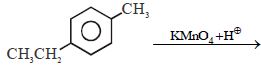
What is the major product of the following reaction ?
  Column $I$   Column $II$
$(A)$ Kohlrausch law can calculate $(P)$ $\frac{{\Lambda _m^c}}{{\Lambda _m^o}}$
$(B)$ Molar conductance ${\Lambda _m}$ $(Q)$ $\frac{1}{R} \times \frac{l}{A}$
$(C)$ Specific conductance Kappa $\to (k)$ $(R)$ $\Lambda _m^o\,of\,c{a_3}{(P{O_4})_2}$
$(D)$ Degree of ionization of weak electrolyte $(S)$ $\frac{{k \times 1000}}{M}$

Which of the following option show correct matches

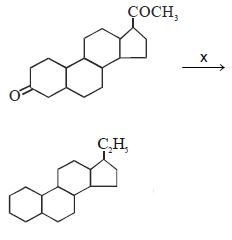
$X$ can be
The compound obtained by heating ethanol with conc. $H _2 SO _4$ at 443 K temperature is :
In electrolysis of dilute ${H_2}S{O_4}$using platinum electrodes
For the given reactions

$Sn ^{2+}+2 e ^{-} \rightarrow Sn$

$Sn ^{4+}+4 e ^{-} \rightarrow Sn$

The electrode potentials are; $E _{ Sn ^{2+} / Sn }^{\circ}=-0.140\, V$ and $E _{ Sn ^{4+} / Sn }^{\circ}=0.010\, V$. The magnitude of standard electrode potential for $Sn ^{4+} / Sn ^{2+}$ i.e. $E _{ Sn ^{4+} / Sn ^{2+}}^{\circ}$ is $.....\times 10^{-2}\, V$. (Nearest integer)

The compound $A$ on treatment with $Na$ gives $B$, and with $\mathrm{PCl}_{5}$ gives $\mathrm{C} . \mathrm{B}$ and $\mathrm{C}$ react together to give diethyl ether. $\mathrm{A}, \mathrm{B}$ and $\mathrm{C}$ are in the order
Acetic anhydride and ammonia gives the product :