MCQ
The most stable ion is
  • A
    $[Fe(C_2O_4)_3]^{3-}$
  • $[Fe(CN)_6]^{3-}­$
  • C
    $[Fe(CN)_6]^{4-}$
  • D
    $[Fe(H_2O)_6]^{3+}$

Answer

Correct option: B.
$[Fe(CN)_6]^{3-}­$
b
Among the given complexes the most stable is $\left[ Fe ( CN )_6\right]^{3-}$ because only this complex is forming a inner orbital complex because of the presence of a strong field ligand and its hybridization is $d^2 s p^3$ while rest of the complexes forms a outer orbital complex which are less stable in comparison.

Need a full question paper?

Generate a complete, print-ready paper with questions like this in minutes — across 16+ boards, with answer keys.

Start Generating Free

Similar questions

In esterification, the reactivity of alcohols is
The oxygen dissolved in water exerts a partial pressure of $20\, kPa$ in the vapour above water. The molar solubility of oxygen in water is ............ $-\times 10^{-5}\, mol\, dm ^{-3}$

(Round off to the Nearest Integer).

[Given : Henry's law constant $= K _{ H }=8.0 \times 10^{4} kPa$ for $O _{2}$ Density of water with dissolved oxygen $=1.0\, kg\, dm ^{-3}$ ]
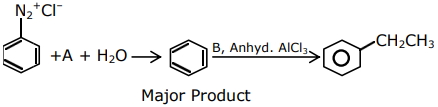
In the chemical reaction given above $A$ and $B$ respectively are :
$C{H_3} - CH = C{H_2}\xrightarrow[{hv\,(low\,conc.)}]{{B{r_2}}}\xrightarrow[{Dry\,ether}]{{Mg}}\xrightarrow[{N{H_4}Cl}]{{\begin{array}{*{20}{c}}
  O \\ 
  {||} \\ 
  {C{H_3} - C - C{H_3}} 
\end{array}}}\xrightarrow[\Delta ]{{{H^ + }}}\mathop {(X)}\limits_{(major)} $

End product $(X)$ of the above reaction is

Metal halide which is insoluble in water is
Standard electrode potential of $A{g^ + }/Ag$ and $C{u^ + }/Cu$ is $ + 0.80\,V$ and $ + 0.34\,V$ respectively. these electrodes are joint together by salt bridge if
Order of number of chelate ring is correct for

$(i)\, [Co(en)_2(Ox)]^+$

$(ii)\, [Fe(Trien)(Ox)]^+$

$(iii)\, [Ca(EDTA)]^{-2}$

$(iv)\, [Pt(Ox)_2 (H_2O)_2]$

In the following sequence of reactions a compound

$A$, (molecular formula $\left.\mathrm{C}_{6} \mathrm{H}_{12} \mathrm{O}_{2}\right)$ with a straight chain structure gives a $C_{4}$ carboxylic acid. $A$ is :

$A \frac{{Li} {A} {H} {H}_{4}}{{H}_{3} {O}^{+}} \longrightarrow B \stackrel{\text { Oxidation }}{\longrightarrow} {C}_{4}-$ carboxylic acid

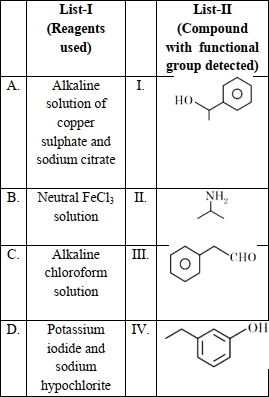
Match List$-I$ with List$-II$ :

Choose the correct answer from the options given below:
$HN{O_3}$ in aqueous solution yields