MCQ
The motion of satellites and planets is:
  • Periodic.
  • B
    Oscillatory.
  • C
    Simple harmonic.
  • D
    Non$-$periodic.

Answer

Correct option: A.
Periodic.
The motion of planets and satellites are repetitive and repeats itself after a fixed interval of time. These type of motions are known as periodic motion.

Need a full question paper?

Generate a complete, print-ready paper with questions like this in minutes — across 16+ boards, with answer keys.
Start Generating Free

Similar questions

The time period of a satellite of earth is $5\, hours$. If the separation between the centre of earth and the satellite is increased to $4\, times$ the previous value, the new time period will become ....... $h$
A bullet $10\,g$ leaves the barrel of gun with a velocity of $600\,m / s$. If the barrel of gun is $50\,cm$ long and mass of gun is $3\,kg$, then value of impulse supplied to the gun will be $.....\,Ns$
A uniform tube of length $60.5\,cm$ is held vertically with its lower end dipped in water. A sound source of frequency $500\,Hz$ sends sound waves into the tube. When the length of tube above water is $16\,cm$ and again when it is $50\,cm,$ the tube resonates with the source of sound. Two lowest frequencies (in $Hz$), to which tube will resonate when it is taken out of water, are (approximately).
A point particle of mass $0.1\, kg$ is executing $S.H.M$. of amplitude of $0.1\, m$. When the particle passes through the mean position, its kinetic energy is $8\times10^{-3}$ Joule. Obtain the equation of motion of this particle if this initial phase of oscillation is $45^o$.
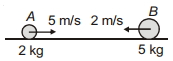
Velocity of the ball $A$ after collision with the ball $B$ as shown in the figure is ............. $m / s$ (Assume perfectly inelastic and headon collision)
An object is moving on a circular track of radius $450\, m$. At some instant, the object is moving at $30\, m/s$ and gaining speed at a uniform rate of $2 m/s^2$. Its acceleration at this instant is nearly  .......... $m/s^2$
If a vector $\vec A$ is parallel to another vector $\vec B$ then the resultant of the vector $\vec A \times \vec B$ will be equal to
A vector is not changed if:
A wire of density $9 \times 10^3 \,kg/m^3$ is stretched between two clamps one meter  apart and is subjected to an extension of $4.9 \times 10^{-4} \,m$. What will be the  lowest frequency of the transverse vibrations in the wire ... $Hz$ $[Y = 9 \times 10^{10} \,N/m^2]$ ?
The ratio of powers of two motors is $\frac{3 \sqrt{x}}{\sqrt{x}+1}$, that are capable of raising $300\,kg$ water in $5$ minutes and $50\,kg$ water in $2$ minutes respectively from a well of $100\,m$ deep. The value of $x$ will be