MCQ
The narrowest hysterisis loop is for:
- ACobalt steel
- BAlmico
- CSoft magnetic material
- DStainless steel
Explanation:
A narrow hysteresis loop implies a small amount of dissipated energy. This occurs as a result of its small area and therefore more frequently repeated reversals of applied magnetising force. Soft magnetic are materials used in devices that require alternating magnetic fields have these narrow hysteresis shapes.
Generate a complete, print-ready paper with questions like this in minutes — across 16+ boards, with answer keys.
The power rating of an electric motor which draws a current of 3.75 amperes when operated at 200 V is about
|
(a) 1 H.P. |
(b) 500 W |
(c) 54 W |
(d) 750 H.P. |
If an electron and a positron annihiliate, then the energy released is
|
(a) 3.2 |
(b) 1.6 |
(c) 4.8 |
(d) 6.4 |
In Young's experiment, the distance between the slits is reduced to half and the distance between the slit and screen is doubled, then the fringe width
|
(a) Will not change |
(b) Will become half |
|
(c) Will be doubled |
(d) Will become four times |
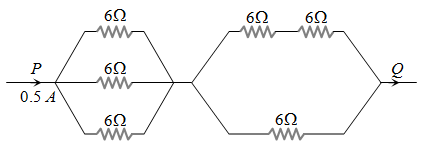
Resistances of 6 ohm each are connected in the manner shown in adjoining figure. With the current 0.5 ampere as shown in figure, the potential difference  is
is
|
(a) 3.6 V |
(b) 6.0 V |
(c) 3.0 V |
(d) 7.2 V |
The equivalent resistance between P and Q in the given figure, is

|
(a) 50 W |
(b) 40 W |
(c) 30 W |
(d) 20 W |
A transformer is employed to
|
(a) Obtain a suitable dc voltage |
(b) Convert dc into ac |
|
(c) Obtain a suitable ac voltage |
(d) Convert ac into dc |
A wire carrying current i is shaped as shown. Section AB is a quarter circle of radius r. The magnetic field is directed

|
(a) At an angle π/4 to the plane of the paper |
|
(b) Perpendicular to the plane of the paper and directed in to the paper |
|
(c) Along the bisector of the angle ACB towards AB |
|
(d) Along the bisector of the angle ACB away from AB |
The voltage gain of a triode depends upon
|
(a) Filament voltage |
(b) Plate voltage |
(c) Plate resistance |
(d) Plate current |
