MCQ
The nature of the graph between potential difference and the electric current flowing through a conductor is :
  • A
    parabolic
  • B
    circle
  • straight line
  • D
    hyperbolic

Answer

Correct option: C.
straight line

Need a full question paper?

Generate a complete, print-ready paper with questions like this in minutes — across 16+ boards, with answer keys.
Start Generating Free

Similar questions

You are asked by your teacher to study the different part of an embryo of a gram seed. Given below are the steps to be followed for the experiment.
  1. Soak the gram seeds in plain water and keep them over might.
  2. Cut open a soaked seed and observe its different parts.
  3. Take some dry gram seeds in a petri dish.
  4. Drain the excess water.
  5. Cover the soaked seed with a wet cotton cloth and leave them for a day.
The correct sequence of these steps is :
During which of the following stages of the circulation of blood in a normal human being, the oxygenated blood is pumped to all parts of the body?
The number of protons in one atom of an element $X$ is $8$ . What will be the number of electrons in its ion $X^{2-}\ ?$
Malachite is an are of :
A myopic person cannot see distinctly, objects that are :
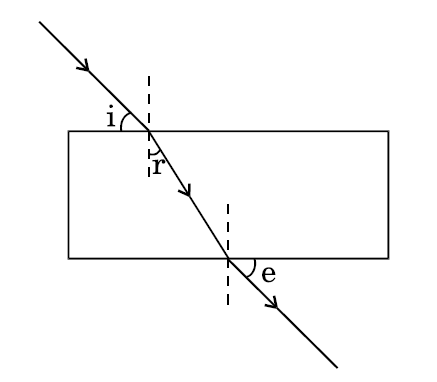
A student traces the path of a ray of light passing through a rectangular glass slab and marks the angle of incidence $i,$ angle of refraction $r$ and angle of emergence $e,$ as shown. The correctly marked angle $(s)$ is/are :
Most of the digestion and absorption of the food takes place in the
Barium chloride on reacting with ammonium sulphate forms barium sulphate and ammonium chloride. Which of the following correctly represents the type of the reaction involved?
  1. Displacement reaction.
  2. Precipitation reaction.
  3. Combination reaction.
  4. Double displacement reaction.
Which of the following gas was not present in early earth atmosphere ?
Rahim recorded the following sets of observations while tracing the path of ray of light passing through a rectangular glass slab for different angles of incidence.
S. No. Angle of incidence Angle of refraction Angle of emergence
$I$ $45^{0}$ $41^{0}$ $45^{0}$
$II$ $40^{0}$ $38^{0}$ $38^{0}$
$III$ $45^{0}$ $41^{0}$ $40^{0}$
$IV$ $41^{0}$ $45^{0}$ $41^{0}$
The correct observation is recorded at serial number: