MCQ
The net applied force on a body in uniform circular motion should always be
  • A
    Constant in magnitude and parallel to direction of motion
  • Constant in magnitude and perpendicular to direction of motion
  • C
    Gravitational in nature
  • D
    Zero

Answer

Correct option: B.
Constant in magnitude and perpendicular to direction of motion
b

Need a full question paper?

Generate a complete, print-ready paper with questions like this in minutes — across 16+ boards, with answer keys.
Start Generating Free

Similar questions

A truck of mass $M$ is at rest on frictionless road when a monkey of mass $m$ starts moving on the truck in forward direction.If the truck recoils with a speed $v$ backward on the road, with what velocity is the monkey moving with respect to truck ?
A wheel having moment of inertia $2\,kg-m^2$ about its vertical axis, rotates at the rate of $60\,rpm$ about the axis. The torque which can stop the wheel’s rotation in one minute would be
Internal forces can change:
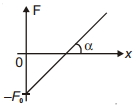
An object starts from rest and is acted upon by a variable force $F$ as shown in figure. If $F_0$ is the initial value of the force, then the position of the object, where it again comes to rest will be
A machine gun is mounted on a $2000 \,kg$ car on a horizontal frictionless surface. At some instant the gun fires bullets of mass $10\, gm$ with a velocity of $500 \,m/sec$ with respect to the car. The number of bullets fired per second is ten, the acceleration of the car will be .....$\,m/{\sec ^2}$
A bird weighs $2 kg$ and is inside a closed cage of $1 kg$. If it starts flying, then what is the weight of the bird and cage assembly  ........... $kg$
A body is projected horizontally with a velocity of $4\ ms^{-1}$. The velocity of the body after $0.7s$ is nearly $($take $g = 10\ ms^{-2}$)
What is minimum length of a tube, open at both ends, that resonates with tuning fork of frequency $350 Hz$ ? [velocity of sound in air $= 350 m/s$]  ..... $cm$
A wire of length $L$ and cross-sectional area $A$ is made of a material of Young's modulus $Y.$ It is stretched by an amount $x$. The work done is
Particle $A$ of mass $m _{1}$ moving with velocity $(\sqrt{3} \hat{i}+\hat{j})\, ms ^{-1}$ collides with another particle $B$ of mass $m _{2}$ which is at rest initially. Let $\overrightarrow{ V }_{1}$ and $\overrightarrow{ V }_{2}$ be the velocities of particles $A$ and $B$ after collision respectively. If $m _{1}=2\, m _{2}$ and after collision $\overrightarrow{ V }_{1}=(\hat{ i }+\sqrt{3} \hat{ j })\, ms ^{-1},$ the angle between $\overrightarrow{ V }_{1}$ and $\overrightarrow{ V }_{2}$ is$......^o$