MCQ
The nitrogen which does not contribute to the basicity of the compound
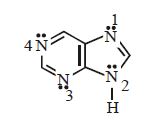
  • $2$
  • B
    $1$
  • C
    $3$
  • D
    $4$

Answer

Correct option: A.
$2$
a

Need a full question paper?

Generate a complete, print-ready paper with questions like this in minutes — across 16+ boards, with answer keys.

Start Generating Free

Similar questions

$C{{H}_{3}}CHO\xrightarrow[{{5}\,^{o}}C]{10\%\,NaOH}\xrightarrow[\Delta ]{}\xrightarrow[Ni]{{{H}_{2}}}(A);$ Product $(A)$ of the reaction is
Given that $\Delta {T_f}$ is the depression in freezing point of the solvent in a solution of a non-volatile solute of molality $m$, the quantity $\mathop {\lim }\limits_{m \to 0} \left( {\frac{{\Delta {T_f}}}{m}} \right)$ is equal to
The current flowing in a copper voltameter is $1.6\, A$. The number of $C{u^{ + + }}$ ions deposited at the cathode per minute are
The number of terminal oxygen atoms present in the product $B$ obtained from the following reaction is $....$

$FeCr _{2} O _{4}+ Na _{2} CO _{3}+ O _{2} \rightarrow A + Fe _{2} O _{3}+ CO _{2}$

$A + H ^{+} \rightarrow B + H _{2} O + Na ^{+}$

Which of following acid remains unaffected on heating ?
An inorganic Compound $'\mathrm{X}^{\prime}$ on treatment with concentrated $\mathrm{H}_{2} \mathrm{SO}_{4}$ produces brown fumes and gives dark brown ring with $\mathrm{FeSO}_{4}$ in presence of concentrated $\mathrm{H}_{2} \mathrm{SO}_{4} .$ Also Compound $'\mathrm{X}'$ gives precipitate $'Y',$ when its solution in dilute $\mathrm{HCI}$ is treated with $\mathrm{H}_{2} \mathrm{~S}$ gas. The precipitate $'Y'$ on treatment with concentrated $\mathrm{HNO}_{3}$ followed by excess of $\mathrm{NH}_{4} \mathrm{OH}$ further gives deep blue coloured solution, Compound $'X'$ is :
The electrolysis of a certain liquid resulted in the formation of hydrogen at the cathode and chlorine at the anode. The liquid is
In given compounds which one does not give glyoxal as one of the product on ozonolysis ?
$\begin{matrix}
   \,\,\,Br\,\,\,Br  \\
   |\,\,\,\,\,\,\,\,|  \\
   C{{H}_{3}}-C-C-C{{H}_{3}}  \\
   |\,\,\,\,\,\,\,\,|  \\
   \,\,Br\,\,\,Br  \\
\end{matrix}\xrightarrow{xNaN{{H}_{2}}}\xrightarrow{y\,C{{H}_{3}}I}C{{H}_{3}}-C\equiv C-C\equiv C-C{{H}_{3}}$

 $x$ and $y$ mole consumed. Value of $x + y =$

Which of the following moleucles do not exist ?