MCQ
The nucleus $_{48}^{115}Cd$ after two successive ${\beta ^ - }$ decays will give
  • A
    $_{46}^{115}Pa$
  • B
    $_{49}^{114}In$
  • C
    $_{50}^{113}Sn$
  • $_{50}^{115}Sn$

Answer

Correct option: D.
$_{50}^{115}Sn$
d
(d) $_{48}C{{d}^{115}}{{\xrightarrow{_{2(-1}{{\beta }^{o}})}}_{\,50}}S{{n}^{115}}$

Need a full question paper?

Generate a complete, print-ready paper with questions like this in minutes — across 16+ boards, with answer keys.
Start Generating Free

Similar questions

Which of the following figure represents the variation of In $\left(\frac{R}{R_{0}}\right)$ with $\ln A$ (If $R=$ radius of a nucleus and $A =$ its mass number)
A negative charge is located in the uniform electric field between two plates $($not shown$).$
Where in the diagram will the electron have the greatest change in potential energy before hitting the one of the plates?
Consider an electron in a hydrogen atom, revolving in its second excited state (having radius $4.65\, \mathop A\limits^o $). The de-Broglie wavelength of this electron is....$\mathop A\limits^o $
Astigmatism (for a human eye) can be removed by using
A double star is a system of two stars rotating about their centre of mass only under their mutual gravitational attraction. Let the star have mass m and 2m and their separation be l. Their time period of rotation about their centre of mass will be proportional to
Graphical variation of electric field due to a uniformly charged insulating solid sphere of radius $R$, with distance $r$ from the centre $O$ is represented by:
The electric field part of an electromagnetic wave in a medium is represented by $E_x = 0\,;$

${E_y} = 2.5\,\frac{N}{C}\,\,\cos \,\left[ {\left( {2\pi \, \times \,{{10}^6}\,\frac{{rad}}{m}} \right)t - \left( {\pi  \times {{10}^{ - 2}}\frac{{rad}}{s}} \right)x} \right];$

$E_z = 0$. The wave is
Permanent magnets are the substances having the property of:
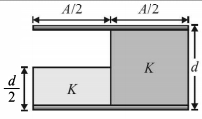
A parallel plate capacitor of area ' $A$ ' plate separation ' $d$ ' is filled with two dielectrics as shown. What is the capacitance of the arrangement?
One of the two identical conducing wires of length $L$ is bent in the form of a circular loop and the other one into a circular coil of $N$ identical turns. If the same current is passed in both, the ratio of the magnetic field at the central of the loop $(B_L)$ to that at the centre of the coil $(B_C),$; $.\,\frac {B_L}{B_C}$ will be