MCQ
The orbital angular momentum of $3p$ electron is
  • A
    $\sqrt 3 h$
  • B
    $\sqrt 6 h$
  • C
    zero
  • $\sqrt 3 \frac{h}{{2\pi }}$

Answer

Correct option: D.
$\sqrt 3 \frac{h}{{2\pi }}$
d

Need a full question paper?

Generate a complete, print-ready paper with questions like this in minutes — across 16+ boards, with answer keys.

Start Generating Free

Similar questions

The molar heat capacity for an ideal gas at constant pressure is $20.785\,J\,K ^{-1}\,mol ^{-1}$. The change in internal energy is $5000\,J$ upon heating it from $300\,K$ to $500\,K$. The number of moles of the gas at constant volume is [Nearest integer] (Given: $R =8.314\,J\,K ^{-1}\,mol ^{-1}$)
Alkyl iodides can be best prepared by
Match List $I$ with List $II$

List $I$ Oxide List $II$ Type of Bond
$A$ $N _2 O _4$ $I$.  $1 N = O$ bond
$B$ $NO _2$ $II$. $1 N - O - N$ bond
$C$ $N _2 O _5$ $III$. $1 N - N$ bond
$D$ $N _2 O$ $IV$.  $1 N = N / N \equiv N$ bond

Choose the correct answer from the options given below:

The solubility product of $\mathrm{Cr}(\mathrm{OH})_{3}$ at $298\; \mathrm{K}$ is $6.0 \times 10^{-31} .$ The concentration of hydroxide ions in a saturated solution of $\mathrm{Cr}(\mathrm{OH})_{3}$ will be
Match the column
Column $-I$ Column $-II$
$(A)$   Ionisation potential $(P)$   $O < F < N$
$(B)$   Electronegativity $(Q)$   $N < O < F$
$(C)$  $Z_{eff}$ $(R)$   $O < N < F$ 
$(D)$   Electron affinity $(S)$    $N < C< O$
The major product in the above reaction is:
An aqueous solution of $6.3$ $g$ of oxalic acid dihydrate is made up of to $250\,\, ml$. The volume of $0.1$ $N\,NaOH$ required to completely neutralise $10\,\, ml$ of this solution is ............. $\mathrm{ml}$
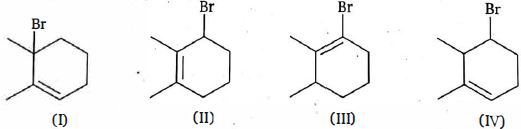
What is the sum of positions assigned to bromine while numbering the Parent Chain in the below compounds ?
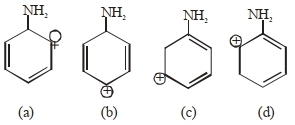
The most stable carbocation for the following is:
$10$ moles of an ideal gas confined to a volume of $10\,L$ is released into atmosphere at $300\, K$ where the pressure is $1\, bar.$ The work done by the gas is ....$L\, bar$

$(R = 0.083\, L\, bar\, K^{-1} \,mol^{-1})$