MCQ
The output of a $NAND$ gate is $0$
  • A
    If both inputs are $ 0$
  • B
    If one input is $ 0$ and the other input is $1$
  • If both inputs are $1$
  • D
    Either if both inputs are $1$ or if one of the inputs is $1$ and the other $0$

Answer

Correct option: C.
If both inputs are $1$
c
(c)If inputs are $A$  and $B$  then output for $NAND$ gate is $Y = \overline {AB} $
==> If $A = B = 1$, $Y = \overline {1.1} = \bar 1 = 0$

Need a full question paper?

Generate a complete, print-ready paper with questions like this in minutes — across 16+ boards, with answer keys.
Start Generating Free

Similar questions

An $A.C.$ circuit containing only capacitance, the current:
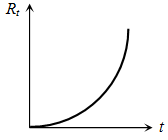
The resistance $R_t$ of a conductor varies with temperature t as shown in the figure. If the variation is represented by$R_t=R_0\left[1+\alpha t+\beta t^2\right]$, then

Which of the following is correct?
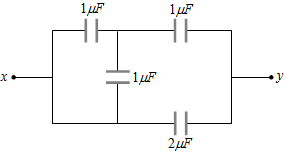
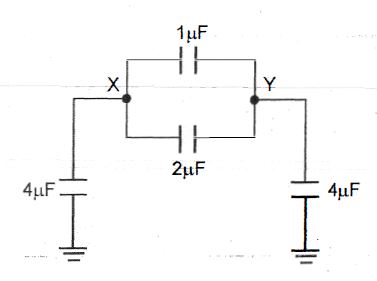
In the circuit shown in figure, the equivalent capacitance between the points $X$ and $Y$ is ......$\mu F$
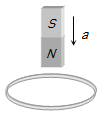
A metallic ring is attached with the wall of a room. When the north pole of a magnet is brought near to it, the induced current in the ring will be


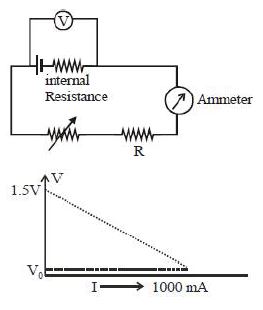
To verify Ohm's law, a student connects the voltmeter across the battery as, shown in the figure. The measured voltage is plotted as a function of the current, and the following graph is obtained If $V_0$ is almost zero, identify the correct statement
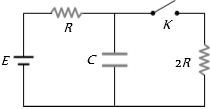
In the circuit, shown in fig. $‘K’$ is open. The charge on capacitor $C$ in steady state is $q_1$. Now key is closed and at steady state, the charge on $C$ is $q_2$. The ratio of charges $\left( {\frac{{{q_1}}}{{{q_2}}}} \right)$ is
Four capacitors are connected as shown in the figure. Their capacities are indicated in the figure. The effective capacitance between points x and y is (in μF)
A nucleus $_Z{X^A}$ emits $9 \alpha$ - particles and $5 \beta$ particle. The ratio of total protons and neutrons in the final nucleus is
According to Joule's law, if potential difference across a conductor of material of resistivity remains constant, then heat produced in the conductor is directly proportional to