The $ P.E.$ of a particle executing $SHM$ at a distance $x$ from its equilibrium position is
Easy
Download our app for free and get started
We know that potential energy is given by,
$PE =\frac{1}{2} kx ^2$
and we know, $\omega^2=\frac{k}{m}$
or, $k =\omega^2 m$
Using value of $k$ in equation $(1)$,
$PE =\frac{1}{2} m \omega^2 x ^2$ is our required answer.

Download our appand get started for free
Experience the future of education. Simply download our apps or reach out to us for more information. Let's shape the future of learning together!No signup needed.*
Similar Questions
- 1View SolutionWhich of the following function represents a simple harmonic oscillation
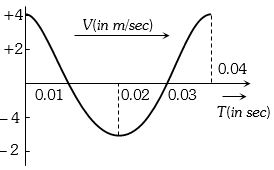
- 2The velocity-time diagram of a harmonic oscillator is shown in the adjoining figure. The frequency of oscillation is ..... $Hz$View Solution
- 3The equation of motion of a particle is $\frac{{{d^2}y}}{{d{t^2}}} + Ky = 0$, where $K$ is positive constant. The time period of the motion is given byView Solution
- 4A vibratory motion is represented by $x = 2\,A\,\cos \,\omega t + A\,\cos \,\left( {\omega t + \frac{\pi }{2}} \right) + A\,\cos \,\left( {\omega t + \pi } \right) + \frac{A}{2}\,\cos \,\left( {\omega t + \frac{{3\pi }}{2}} \right)$ The resultant amplitude of motion isView Solution
- 5Two particles are executing simple harmonic motion of the same amplitude $A$ and frequency $\omega $ along the $x-$ axis. Their mean position is separated by distance $X_0 (X_0> A)$. If the maximum separation between them is $(X_0 +A)$, the phase difference between their motion isView Solution
- 6When two displacements represented by $y_1 = asin\left( \omega t \right)$ and $y_2 = bcos\left(\omega t \right)$ are superimposed the motion isView Solution
- 7A ring of diameter $2m$ oscillates as a compound pendulum about a horizontal axis passing through a point at its rim. It oscillates such that its centre move in a plane which is perpendicular to the plane of the ring. The equivalent length of the simple pendulum is .... $m$View Solution
- 8A particle executes linear simple harmonic motion with an amplitude of $2\, cm$. When the particle is at $1\, cm$ from the mean position the magnitude of its velocity is equal to that of its acceleration. Then its time period in seconds isView Solution
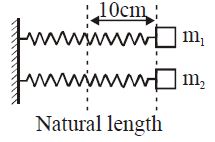
- 9The drawing shows a top view of a frictionless horizontal surface, where there are two indentical springs with particles of mass $m_1$ and $m_2$ attached to them. Each spring has a spring constant of $1200\ N/m.$ The particles are pulled to the right and then released from the positions shown in the drawing. How much time passes before the particles are again side by side for the first time if $m_1 = 3.0\ kg$ and $m_2 = 27 \,kg \,?$View Solution
- 10The height of liquid column in a $U$ tube is $0.3$ meter. If the liquid in one of the limbs is depressed and then released, then the time period of liquid column will be $.......\,sec$View Solution