A particle executes linear simple harmonic motion with an amplitude of $2\, cm$. When the particle is at $1\, cm$ from the mean position the magnitude of its velocity is equal to that of its acceleration. Then its time period in seconds is
Medium
Download our app for free and get started
(c) Velocity $v = \omega \sqrt {{A^2} - {x^2}} $ and acceleration $ = {\omega ^2}x$
Now given, ${\omega ^2}x = \omega \sqrt {{A^2} - {x^2}} $
==> ${\omega ^2}.1 = \omega \sqrt {{2^2} - {1^2}} $
==> $\omega = \sqrt 3 $
$T = \frac{{2\pi }}{\omega } = \frac{{2\pi }}{{\sqrt 3 }}$

Download our appand get started for free
Experience the future of education. Simply download our apps or reach out to us for more information. Let's shape the future of learning together!No signup needed.*
Similar Questions
- 1A particle is performing $SHM$ according to the equation $x = (3\, cm)$ $\sin \,\left( {\frac{{2\pi t}}{{18}} + \frac{\pi }{6}} \right)$ where $t$ is in seconds. The distance travelled by the particle in $36\, s$ is ..... $cm$View Solution
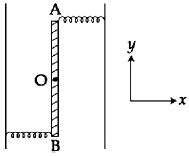
- 2Two light identical springs of spring constant $k$ are attached horizontally at the two ends of a uniform horizontal rod $AB$ of length $l$ and mass $m$. the rod is pivoted at its centre $‘O’$ and can rotate freely in horizontal plane. The other ends of the two springs are fixed to rigid supports as shown in figure. The rod is gently pushed through a small angle and released. The frequency of resulting oscillation isView Solution
- 3A mass $m$ attached to a spring oscillates with a period of $3\,s$. If the mass is increased by $1\,kg$ the period increases by $1\,s$. The initial mass $m$ isView Solution
- 4Two simple pendulums of lengths $1.44 \,m$ and $1\, m$ start swinging together. After how many vibrations will they again start swinging togetherView Solution
- 5A $1.00 \times {10^{ - 20}}kg$ particle is vibrating with simple harmonic motion with a period of $1.00 \times {10^{ - 5}}sec$ and a maximum speed of $1.00 \times {10^3}m/s$. The maximum displacement of the particle isView Solution
- 6A particle executes linear simple harmonic motion with an amplitude of $2\, cm$. When the particle is at $1\, cm$ from the mean position the magnitude of its velocity is equal to that of its acceleration. Then its time period in seconds isView Solution
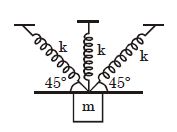
- 7Initially system is in equilibrium. Time period of $SHM$ of block in vertical direction isView Solution
- 8A mass at the end of a spring executes harmonic motion about an equilibrium position with an amplitude $A.$ Its speed as it passes through the equilibrium position is $V.$ If extended $2A$ and released, the speed of the mass passing through the equilibrium position will beView Solution
- 9The kinetic energy and the potential energy of a particle executing $S.H.M.$ are equal. The ratio of its displacement and amplitude will beView Solution
- 10The motion of a particle executing $S.H.M.$ is given by $x = 0.01\sin 100\pi (t + .05)$, where $x$ is in metres and time is in seconds. The time period is ..... $\sec$View Solution