The $ P.E.$ of a particle executing $SHM$ at a distance $x$ from its equilibrium position is
Easy


Download our appand get started for free
Experience the future of education. Simply download our apps or reach out to us for more information. Let's shape the future of learning together!No signup needed.*
Similar Questions
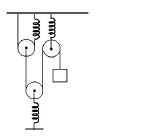
- 1Assuming all pulleys, springs and string massless. Consider all surface smooth. Choose the correct statement $(s)$View Solution
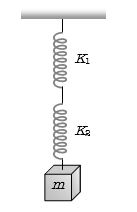
- 2View SolutionThe frequency of oscillation of the springs shown in the figure will be
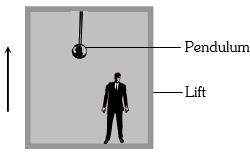
- 3A man measures the period of a simple pendulum inside a stationary lift and finds it to be $T$ sec. If the lift accelerates upwards with an acceleration $\frac{g}{4}$, then the period of the pendulum will beView Solution
- 4A particle of mass $10$ grams is executing simple harmonic motion with an amplitude of $0.5\, m$ and periodic time of $(\pi /5)$ seconds. The maximum value of the force acting on the particle is ... $N$View Solution
- 5The displacement y of a particle executing periodic motion is given by $y = 4{\cos ^2}(t/2)\sin (1000t)$. This expression may be considered to be a result of the superposition of ........... independent harmonic motionsView Solution
- 6The total energy of a particle executing $S.H.M.$ is $80 \,J$. What is the potential energy when the particle is at a distance of $\frac{3}{4}$ of amplitude from the mean position..... $J$View Solution
- 7A simple pendulum consisting of a light inextensible string of length $\ell$ attached to a heavy small bob of mass $m$ is at rest. The bob is imparted a horizontal impulsive force which gives it a speed of $\sqrt{4 g \ell}$. The speed of the bob at its highest point is ( $g$ is the accelaration due to gravity)View Solution
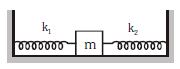
- 8A block of mass $m$ is attached to two springs of spring constants $k_1$ and $k_2$ as shown in figure. The block is displaced by $x$ towards right and released. The velocity of the block when it is at $x/2$ will beView Solution
- 9The displacement of a particle varies according to the relation $x = 3 \ sin\ 100t + 8\ cos^2\ 50t$ . Which of the following is incorrect about this motionView Solution
- 10The displacement of an oscillating particle varies with time (in seconds) according to the equation $y (cm) = sin \frac{\pi }{2}\left( {\frac{t}{2} + \frac{1}{3}} \right)$. The maximum acceleration of the particle is approximately ..... $cm/s^2$View Solution