Question
The pendulum of a clock is replaced by a spring-mass system with the spring having spring constant 0.1N/m. What mass should be attached to the spring?

Answer

$\text{k}=0.1\text{N/m}$

$\text{T}=2\pi\sqrt{\frac{\text{m}}{\text{k}}}=2\sec$ [Time period of pendulum of a clock = 2 sec]

So, $4\pi^{2+}\Big(\frac{\text{m}}{\text{k}}\Big)=4$

$\therefore\text{m}=\frac{\text{k}}{\pi^2}=\frac{0.1}{10}=0.01\text{kg}\approx10\text{gm}.$

Need a full question paper?

Generate a complete, print-ready paper with questions like this in minutes — across 16+ boards, with answer keys.
Start Generating Free

Similar questions

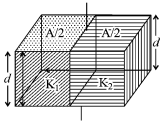
Two dielectric blocks (whose dielectric constants are $K_1$ and $K_2$, respectively) are filled between the plates of a parallel plate capacitor as shown in the figure. What will be the capacitance of the capacitor?
Image
Why do semiconductors obey Ohm's law for only low fields?
A power transmission line feeds input power at 2300V to a stepdown transformer with its primary windings having 4000 turns. What should be the number of turns in the secondary in order to get output power at 230 V?
Light is incident from glass $(\mu=1.5)$ to air. Sketch the variation of the angle of deviation $\delta$ with the angle of incident i for 0 < i < 90°.
Find the electric force between two protons separated by a distance of 1 fermi (1 fermi = 10-15m). The protons in a nucleus remain at a separation of this order.
Sketch graph to show how charge Q given to a capacitor of capacitance C varies with the potential difference.
An electron is accelerated through a potential difference of 100 volts. What is the de-Broglie wavelength associated with it? To which part of the electromagnetic spectrum does this value of wavelength correspond?
Verify that the units weber and volt-second are the same.
Why does microwave oven heats up a food item containing water molecules most efficiently?
The refractive index of a material of a concave lens is n1. It is immersed in a medium of refractive index n2 A parallel beam of light is incident on the lens. Trace the path of emergent rays when (i) n2 = n1 (ii) n2 > n1 (iii) n2 < n1.
$\frac{1}{\text{f}}=\Big(\frac{\text{n}_1}{\text{n}_2}-1\Big)\Big(\frac{1}{\text{R}_2}-\frac{1}{\text{R}_2}\Big)$