Question
An electron is accelerated through a potential difference of 100 volts. What is the de-Broglie wavelength associated with it? To which part of the electromagnetic spectrum does this value of wavelength correspond?

Answer

$\lambda = \frac{\text{h}}{\sqrt{2\text{meV}}}\text{ or } \lambda = \frac{12.27}{\sqrt{\text{V}}}\mathring{\text{A}}$
$\lambda =\frac{12.27}{\sqrt{100}}\mathring{\text{A}} = \frac{12.27}{10}\mathring{\text{A}}=1.227\mathring{\text{A}}$
This wavelength corresponds to the X rays.

Need a full question paper?

Generate a complete, print-ready paper with questions like this in minutes — across 16+ boards, with answer keys.
Start Generating Free

Similar questions

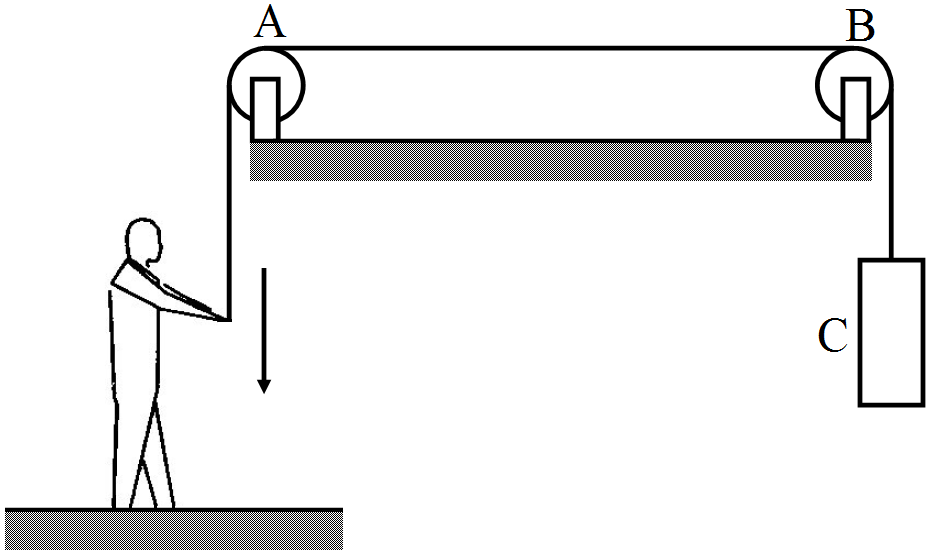
List all the forces acting on:
  1. The pulley A.
  2. The boy and.
  3. The block C in figure.

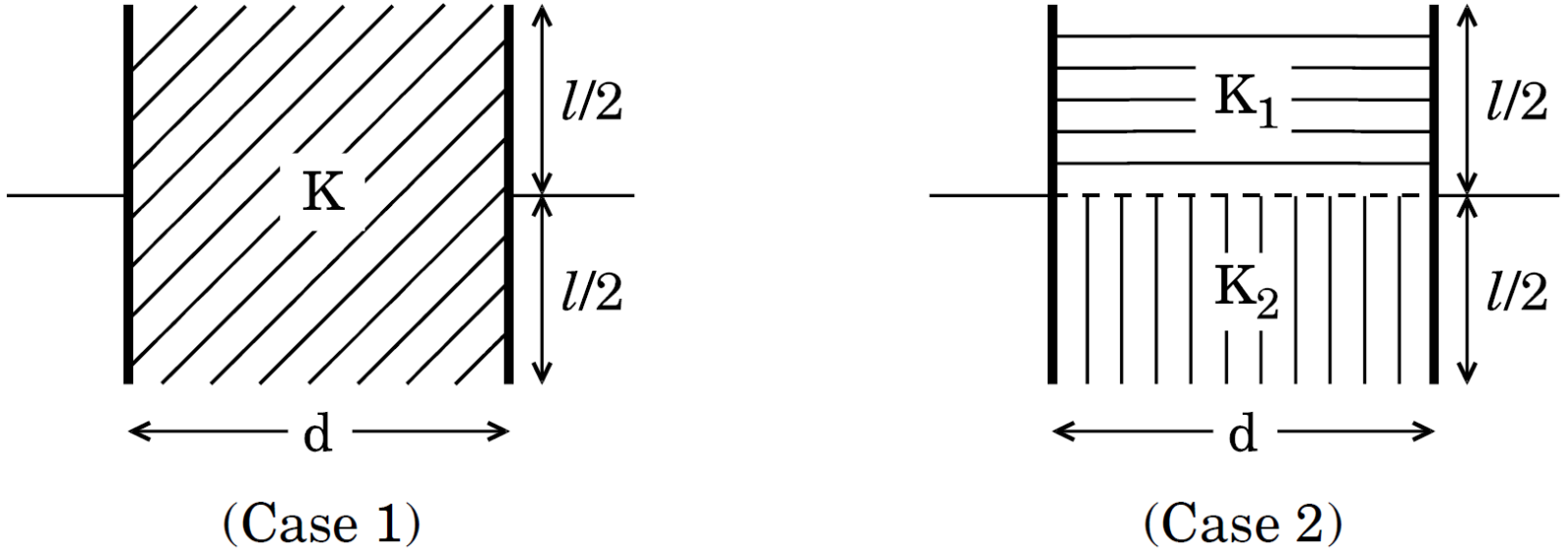
The space between the plates of a parallel plate capacitor is completely filled in two ways. In the first case, it is filled with a slab of dielectric constant K. In the second case, it is filled with two slabs of equal thickness and dielectric constants K1 and K2 respectively as shown in the figure. The capacitance of the capacitor is same in the two cases. Obtain the relationship between K, K1 and K2.

Explain the unit of mass.
Explain electric field produced by the point electric charge.
The separation between the consecutive dark fringes in a Young's double slit experiment is 1.0mm. The screen is placed at a distance of 2.5m from the slits and the separation between the slits is 1.0mm. Calculate the wavelength of light used for the experiment.
Explain : Why we can consider quantisation of charge for microscopic level but not for macroscopic level ?
Show that the radius of the orbit in hydrogen atom varies as n2, where n is the principal quantum number of the atom.
Explain diamagnetism and diamagnetic material.
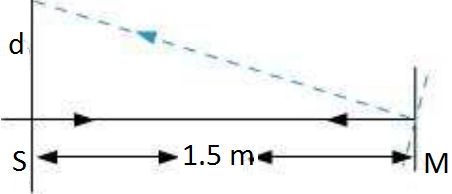
Light incident normally on a plane mirror attached to a galvanometer coil retraces backwards. A current in the coil produces a deflection of 3.5° of the mirror. What is the displacement of the reflected spot of light on a screen placed 1.5 m away?

The linewidth of a bright fringe is sometimes defined as the separation between the points on the two sides of the central line where the intensity falls to half the maximum. Find the linewidth of a bright fringe in a Young's double slit experiment in terms of $\lambda$, d and D where the symbols have their usual meanings.