Question
The pendulum of a clock is replaced by a spring-mass system with the spring having spring constant 0.1N/m. What mass should be attached to the spring?

Answer

$\text{k}=0.1\text{N/m}$$\text{T}=2\pi\sqrt{\frac{\text{m}}{\text{k}}}=2\sec$ [Time period of pendulum of a clock = 2 sec]
So, $4\pi^{2+}\Big(\frac{\text{m}}{\text{k}}\Big)=4$
$\therefore\text{m}=\frac{\text{k}}{\pi^2}=\frac{0.1}{10}=0.01\text{kg}\approx10\text{gm}.$

Need a full question paper?

Generate a complete, print-ready paper with questions like this in minutes — across 16+ boards, with answer keys.
Start Generating Free

Similar questions

de Broglie wavelength associated with an electron accelerated through a potential difference V is $\lambda$ What will be the de Broglie wavelength when the accelerating potential is increased to 4V?
The charge on a proton is $+1.6 \times 10^{-19} \mathrm{C}$ and that on an electron is $-1.6 \times 10^{-19} \mathrm{C}$. Does it mean that the electron has a charge $3.2 \times 10^{-19} \mathrm{C}$ less than the charge of a proton?
An uncharged capacitor is connected to a battery. Show that half of the energy used by the battery to charge the capacitor is dissipated as heat.
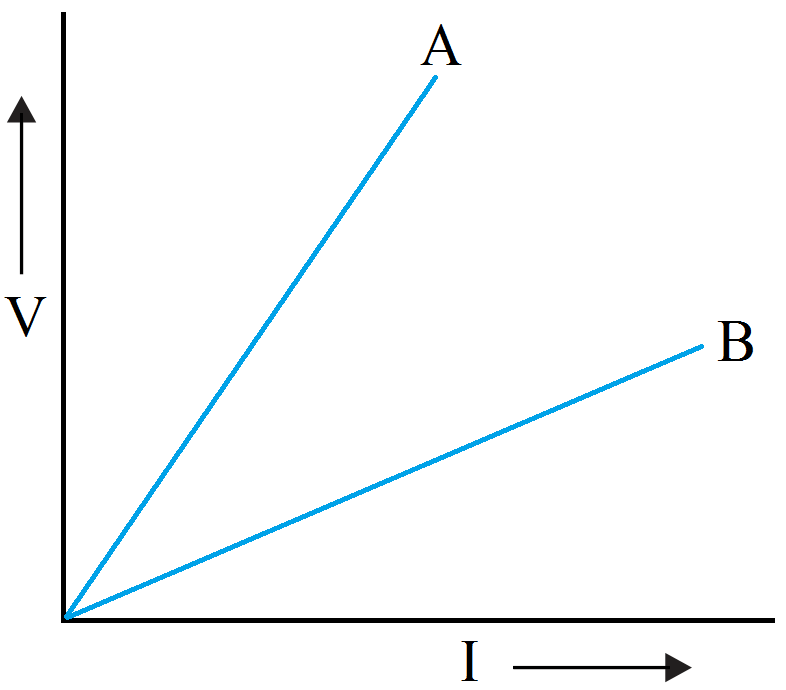
V-I graphs for parallel and series combinations of two metallic resistors are shown in figure. Which graph represents parallel combination? Justify your answer.
When an electron falls from a higher energy to a lower energy level, the difference in the energies appears in the form of electromagnetic radiation. Why cannot it be emitted as other forms of energy?
What is stationary interference? How can we get, the resultant intensity of super position of waves emanated from the incoherent sources?
A concave mirror and a converging lens have the same focal length in air. Which one of the two will have greater focal length when both are immersed in water?
Find the average magnitude of linear momentum of a helium molecule in a sample of helium gas at 0°C. Mass of a helium molecule $= 6.64 \times 10^{-27}kg$ nd Boltzmann constant $= 1.38 \times 10^{-23}JK^{-1}.$
Give examples where:
  1. The velocity of a particle is zero but its acceleration is not zero.
  2. The velocity is opposite in direction to the acceleration.
  3. The velocity is perpendicular to the acceleration.
Write the formula to determine the refractive index of the material of the prism in the case of minimum deviation.