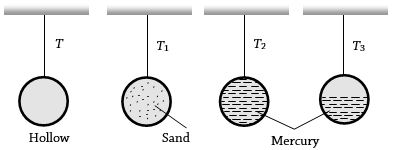
The period of a simple pendulum, whose bob is a hollow metallic sphere, is $T$.The period is $T_1$ when the bob is filled with sand, $T_2$ when it is filled with mercury and $T_3$ when it is half filled with mercury. Which of the following is true
Medium


Download our appand get started for free
Experience the future of education. Simply download our apps or reach out to us for more information. Let's shape the future of learning together!No signup needed.*
Similar Questions
- 1There is a simple pendulum hanging from the ceiling of a lift. When the lift is stand still, the time period of the pendulum is $T$. If the resultant acceleration becomes $g/4,$ then the new time period of the pendulum isView Solution
- 2A particle executes $SHM$ on a straight line path. The amplitude of oscillation is $2\, cm.$ When the displacement of the particle from the mean position is $1\, cm,$ the numerical value of magnitude of acceleration is equal to the numerical value of magnitude of velocity. The frequency of $SHM$ (in $second^{-1}$) is :View Solution
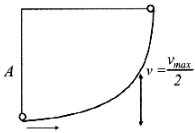
- 3A particle starts with $S.H.M.$ from the mean position as shown in the figure. Its amplitude is $A$ and its time period is $T$. At one time, its speed is half that of the maximum speed. What is this displacement?View Solution
- 4View SolutionThe velocity of a particle performing simple harmonic motion, when it passes through its mean position is
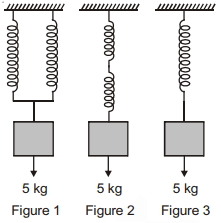
- 5Two identical springs have the same force constant $73.5 \,Nm ^{-1}$. The elongation produced in each spring in three cases shown in Figure-$1$, Figure-$2$ and Figure-$3$ are $\left(g=9.8 \,ms ^{-2}\right)$View Solution
- 6If $< E >$ and $< U >$ denote the average kinetic and the average potential energies respectively of mass describing a simple harmonic motion, over one period, then the correct relation isView Solution
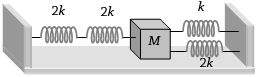
- 7Four massless springs whose force constants are $2k, 2k, k$ and $2k$ respectively are attached to a mass $M$ kept on a frictionless plane (as shown in figure). If the mass $M$ is displaced in the horizontal direction, then the frequency of oscillation of the system isView Solution
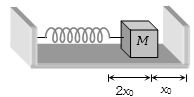
- 8One end of a spring of force constant k is fixed to a vertical wall and the other to a block of mass m resting on a smooth horizontal surface. There is another wall at a distance ${x_0}$ from the black. The spring is then compressed by $2{x_0}$ and released. The time taken to strike the wall isView Solution
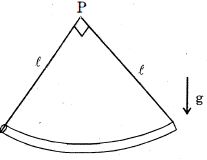
- 9A circular arc of mass $m$ is connected with the help of two massless strings as shown in the figuw in vertical plane. About point $P$, small oscillations are given in the plane of the arc. Time period of the oscillations of $SHM$ will beView Solution
- 10View SolutionIdentify the function which represents a periodic motion.