MCQ
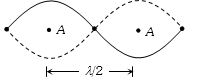
The phase difference between the two particles situated on both the sides of a node is ... $^o$
  • A
    $0$
  • B
    $90$
  • $180$
  • D
    $360$

Answer

Correct option: C.
$180$
c
(c)Both the sides of a node, two antinodes are present with separation $\frac{\lambda }{2}$

So phase difference between then $\phi = \frac{{2\pi }}{\lambda } \times \frac{\lambda }{2} = \pi $
Need a full question paper?

Generate a complete, print-ready paper with questions like this in minutes — across 16+ boards, with answer keys.

Start Generating Free

Similar questions

The length of a uniform rod is $100.0 \,cm$ and radius is $1.00 \,cm$. If length is measured with a meter rod having least count $1 \,mm$ and radius is measured with vernier callipers having least count $0.1 \,mm$, the percentage error in calculated volume of cylinder is ............. $\%$
An organ pipe of length $L$ is open at one end and closed at other end. The wavelengths of the three lowest resonating frequencies that can be produced by this pipe are
$1\,eV$ is
A beam of metal supported at the two ends is loaded at the centre. The depression at the centre is proportional to
Which of the following quantities has a unit but dimensionless?
In an organ pipe whose one end is at $x = 0$, the pressure is expressed by $p = {p_0}\cos \frac{{3\pi x}}{2} \,\,sin\,\, 300\pi t$  where $x$ is in meter and $t$ in $sec$. The organ pipe can be
Air is streaming past a horizontal air plane wing such that its speed in $ 120 m/s$  over the upper surface and $ 90 m/s$  at the lower surface. If the density of air is $1.3 kg$  per $metre^3 $ and the wing is $10 m $ long and has an average width of $2 m$, then the difference of the pressure on the two sides of the wing of ....... $Pascal$ 
A man of mass $40\, kg$ is standing on a trolley $A$ of mass $140 \,kg$ . He pushes another trolley $B$ of same material of mass $60\, kg$, so that they are set in motion . Then :
If a soap bubble expands, the pressure inside the bubble:
The radius of gyration of a disc of mass $50\,g$ and radius $2.5\,cm$ , about an axis passing through its centre of gravity and perpendicular to the plane, is ....... $cm$.