MCQ
The phase of a particle performing simple harmonic $\frac{\pi}{2}$ while its:
  • A
    the value of energy should be maximum
  • the displacement should be maximum
  • C
    the velocity should be maximum
  • D
    the value of acceleration should be maximum

Answer

Correct option: B.
the displacement should be maximum
(B)

Need a full question paper?

Generate a complete, print-ready paper with questions like this in minutes — across 16+ boards, with answer keys.
Start Generating Free

Similar questions

Fundamental frequency of pipe is $100 Hz$ and other two frequencies are $300 Hz$ and $500 Hz$ then
A spaceship of mass $2 \times 10^4\,kg$ is launched into a circular orbit close to the earth surface. The additional velocity to be imparted to the spaceship in the orbit to overcome the gravitational pull will be $......$ (if $g =10\,m / s ^2$ and radius of earth $=6400\,km$ )
In which of the following graphs, the total change in momentum is zero?
The height of liquid column raised in a capillary tube of certain radius when dipped in liquid A vertically is, $5 cm$. If the tube is dipped in a similar manner in another liquid $B$ of surface tension and density double the values of liquid $A$, the height of liquid column raised in liquid $B$ would be $........m$.
A black body of surface area $10cm^2$ is heated to $127°C$ and is suspended in a room at temperature $27°C$ . The initial rate of loss of heat from the body at the room temperature will be ...... $W$
Radius of a soap bubble is increased from R to 2R. Work done in this process in terms of surface tension is:
The upper end of a wire of radius $4\, mm$ and length $100\, cm$ is clamped and its other end is twisted through an angle of $30°$. Then angle of shear is ..... $^o$
The graph between pressure $(P)$ and $\frac{1}{V}$ ($V$ is volume) for constant temperature process in ideal equation  $(PV = nRT)$
The mass number of a nucleus is:
  1. Always less than its atomic number.
  2. Always more than its atomic number.
  3. Equal to its atomic number.
  4. Sometimes more than and sometimes equal to its atomic number.
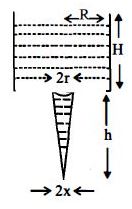
 Consider a water jar of radius $R$ that has water filled up to height $H$ and is kept on a stand of height $h$ (see figure) . Through a hole of radius $r$  $(r << R)$ at its bottom, the water leaks out and the stream of water coming down towards the ground has a shape like a funnel as shown in the figure. If the radius of the cross-section of water stream when it hits the ground is $x.$ Then