MCQ
The photoelectric effect can be understood on the basis of:
- AWave theroy of light only.
- BElectromagnetic theory of light only.
- CQuantum theory of light only.
- DNone of these.
Generate a complete, print-ready paper with questions like this in minutes — across 16+ boards, with answer keys.
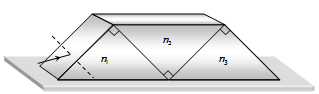
Three right angled prisms of refractive indices  and
and  are fixed together using an optical glue as shown in figure. If a ray passes through the prisms without suffering any deviation, then
|
(a) |
(b) |
|
(c) |
(d) 1 + |
Correct statements are.
A beam of light is converging towards a point I on a screen. A plane glass plate whose thickness in the direction of the beam = t, refractive index = μ, is introduced in the path of the beam. The convergence point is shifted by
|
(a) |
(b) |
(c) |
(d) |
An ammeter whose resistance is 180 Ω gives full scale deflection when current is 2 mA. The shunt required to convert it into an ammeter reading 20 mA (in ohms) is
|
(a) 18 |
(b) 20 |
(c) 0.1 |
(d) 10 |
In extrinsic P and N-type, semiconductor materials, the ratio of the impurity atoms to the pure semiconductor atoms is about
|
(a) 1 |
(b) |
(c) |
(d) |
The kinetic energy of an electron with de-Broglie wavelength of 0.3 nanometer is
|
(a) 0.168 eV |
(b) 16.8 eV |
(c) 1.68 eV |
(d) 2.5 eV |
Light of wavelength  strikes a photo-sensitive surface and electrons are ejected with kinetic energy E. If the kinetic energy is to be increased to 2E, the wavelength must be changed to
  where
where
|
(a) |
(b) |
(c) |
(d) |





