The piston in the cylinder head of locomotive has a stroke of $6\,m$ (which is twice the amplitude). If the piston executing simple harmonic motion with an angular frequency of $200\, rad\, min^{-1}$, its maximum speed is .... $ms^{-1}$
Medium
Download our app for free and get started
Amplitude $=\frac{6}{2}=3 \mathrm{m}$
$\mathrm{V}_{\max }=\mathrm{A} \omega=3 \times \frac{200}{60}=10 \mathrm{ms}^{-1}$

Download our appand get started for free
Experience the future of education. Simply download our apps or reach out to us for more information. Let's shape the future of learning together!No signup needed.*
Similar Questions
- 1A particle is performing simple harmonic motion along $x-$axis with amplitude $4 \,cm$ and time period $1.2\, sec$. The minimum time taken by the particle to move from $x =2 ,cm$ to $ x = + 4\, cm$ and back again is given by .... $\sec$View Solution
- 2Two particles oscillating in $SHM$ along two very close parallel path such that they have same mean position. The equation of $SHM$ of two particles are $x_1 = A\, sin\,\omega t$ and $x_2 = A\,sin(\omega t + \phi )$ respectively. If maximum distance between them is $\frac{6A}{5}$ then $\phi $ equal to ..... $^o$View Solution
- 3View SolutionMark the wrong statement
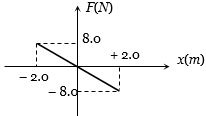
- 4A body of mass $0.01 kg$ executes simple harmonic motion $(S.H.M.)$ about $x = 0$ under the influence of a force shown below : The period of the $S.H.M.$ is .... $s$View Solution
- 5A particle is placed at the lowest point of a smooth wire frame in the shape of a parabola, lying in the vertical $xy-$ plane having equation $x^2 = 5y$ $(x, y$ are in meter). After slight displacement, the particle is set free. Find angular frequency of oscillation.....$rad/s$ (in $rad/sec$ ) (take $g = 10\ m/s^2$ )View Solution
- 6A point mass oscillates along the x-axis according to the law $x=x_0cos$$\left( {\omega t - \frac{\pi }{4}} \right)$ If the acceleration of the particle is written as $a=Acos$$\left( {\omega t + \delta } \right)$ thenView Solution
- 7A simple harmonic motion is represented by $y\, = 5\,(\sin \,3\pi t\, + \,\sqrt 3 \,\cos \,3\pi t)\,cm$ The amplitude and time period of the motion areView Solution
- 8A force of $6.4\, N$ stretches a vertical spring by $0.1 \,m$. The mass that must be suspended from the spring so that it oscillates with a period of $\left( {\frac{\pi }{4}} \right)sec$. is ... $kg$View Solution
- 9When a mass $m$ is hung from the lower end of a spring of neglibgible mass, an extension $x$ is produced in the spring. The time period of oscillation isView Solution
- 10View SolutionWhich of the diagrams shown in figure represents variation of total mechanical energy of a pendulum oscillating in water as function of time ?