MCQ
The pointer of a dead-beat galvanometer gives a steady deflection because
  • Eddy currents are produced in the conducting frame over which the coil is wound
  • B
    Its magnet is very strong
  • C
    Its pointer is very light
  • D
    Its frame is made of abonite

Answer

Correct option: A.
Eddy currents are produced in the conducting frame over which the coil is wound
a
A galvanometer gives steady deflection.

The pointer of a dead-beat garranometer shouls steady state deflection as eddy-cumments are generated due to the coil coound. This eddy-cumment is due to the coil which is wound and produced in the conducting fuame.

Need a full question paper?

Generate a complete, print-ready paper with questions like this in minutes — across 16+ boards, with answer keys.
Start Generating Free

Similar questions

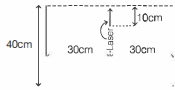
A water-proof laser pointer of length $10 \,cm$ placed in a water tank rotates about a horizontal axis passing through its centre of mass in a vertical plane as shown in the figure. The time period of rotation is $60 \,s$. Assuming the water to be still and no reflections from the surface of the tank, the duration for which the light beam escapes the tank in one time period is close to ............. $s$ (Take, refractive index of water $=1.33$ )
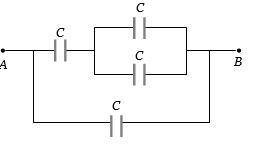
Four equal capacitors, each of capacity $C$, are arranged as shown. The effective capacitance between $A$ and $B$ is
When the speed of a $dc$ motor increases the armature current
The ratio of the dimension of Planck's constant and that of moment of inertia is the dimension of
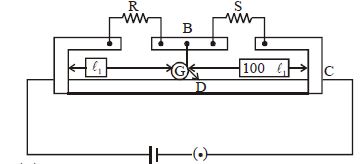
In a meter bridge the point $D$ is neutral point as shown in the figure.
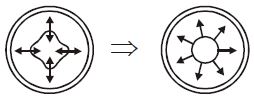
A soap film is formed on a circular frame. A loop of thread is lying on film. If the film inside the loop is broken, then tension in the thread will be : ($R =$ radius of loop, $T =$ surface tension of liquid)
To compare magnetic moments of two magnets by vibration magnetometer, 'sum and difference method' is better because
Three copper rods are subjected to different potential difference. Compare the drift speed of electrons through them. Assume that all $3$ are at the same temperature.
  Length Diameter Potential difference
$(A)$ $L$ $3d$ $V$
$(B)$ $2L$ $d$ $2V$
$(C)$ $3L$ $2d$ $2V$
Mercury boils at $367°C$. However, mercury thermometers are made such that they can measure temperature up to $500°C$. This is done by
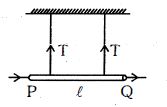
A conducting bar $PQ$ of length $l$ carrying current $I$ is suspended from a rigid support as shown in figure. A uniform magnetic field $B$ perpendicular to $PQ$ and directed away from the reader (inside the plane) is applied. If the mass of the bar is $M$ the tension in each string is