MCQ
The points $O,A,B,C,D$ are such that $\overrightarrow {OA}  = \vec a,\,\overrightarrow {OB}  = \vec b,\,$ $\overrightarrow {OC}  = \,2\vec a + 3\vec b\,$ and$ \,\overrightarrow {OD}  = \,\vec a - 2\vec b.\,\,$ If $ \,\left| {\vec a} \right|\, = 3\left| {\vec b,} \right|$ then the angle between $\overrightarrow {BD} $ and $\overrightarrow {AC} $ is
  • A
    $\frac{\pi }{3}$
  • B
    $\frac{\pi }{4}$
  • C
    $\frac{\pi }{6}$
  • $\frac{\pi }{2}$

Answer

Correct option: D.
$\frac{\pi }{2}$
d
We have $\overrightarrow{\mathrm{BD}}=\overrightarrow{\mathrm{OD}}-\overrightarrow{\mathrm{OB}}=a-2 b-b=a-3 b$ and

$\overrightarrow{\mathrm{AC}}=\overrightarrow{\mathrm{OC}}-\overrightarrow{\mathrm{OA}}=2 a+3 b-a=a+3 b$

Let $\theta$ be the angle between $\overrightarrow{\mathrm{BD}}$ and $\overrightarrow{\mathrm{AC}}$

Then $\cos \theta  = \frac{{\overrightarrow {{\rm{BD}}}  \cdot \overrightarrow {\overline {{\rm{AC}}} } }}{{|\overrightarrow {{\rm{BD}}} ||\overrightarrow {{\rm{AC}}} |}} = \frac{{|{\rm{a}}{|^2} - 9|{\rm{b}}{|^2}}}{{|\overrightarrow {{\rm{BD}}} \overrightarrow {{\rm{AC}}} |}}$

$=\frac{9|\mathrm{b}|^{2}-9|\mathrm{b}|^{2}}{|\overrightarrow{\mathrm{BD}}||\overrightarrow{\mathrm{AC}}|},(\therefore|\mathrm{a}|=3|\mathrm{b}|)$

$\Rightarrow \cos \theta=0 \Rightarrow \theta=\frac{\pi}{2}$

Need a full question paper?

Generate a complete, print-ready paper with questions like this in minutes — across 16+ boards, with answer keys.

Start Generating Free

Similar questions

If $\int_{}^{} {\frac{{{e^x}(1 + \sin x)dx}}{{1 + \cos x}} = {e^x}f(x) + c} $, then $f(x) = $
Let $A$ be a $2 \times 2$ real matrix and $I$ be the identity matrix of order $2$ . If the roots of the equation $|A-x I|=0$ be $-1$ and $3$ , then the sum of the diagonal elements of the matrix $A^2$ is$..............$
If $A$ is an invertible matrix of order $3$, then which of the following is not true:
Let $f:[1, \infty) \rightarrow[2, \infty)$ be a differentiable function such that $f(1)=2$. If $6 \int_1^x f(t) d t=3 x f(x)-x^3$ for all $x \geq 1$, then the value of $f(2)$ is
If $\int\limits_0^{\frac{\pi }{3}} {\frac{{\tan \,\,\theta }}{{\sqrt {2k\,\sec \,\theta } }}} \,d\theta \, = \,1 - \frac{1}{{\sqrt 2 }},(k > 0),$ then the value of $k$ is
Let $| X |$ denote the number of elements in set $X$. Let $S =\{1,2,3,4,5,6\}$ be a sample space, where each element is equally likely to occur. If $A$ and $B$ are indepenent events associated with $S$, then the number of ordered pairs $(A, B)$ such that $1 \leq|B|<|A|$, equals
If ${I_1} = \int_0^1 {{2^{{x^2}}}dx,\;} {I_2} = \int_0^1 {{2^{{x^3}}}dx} ,\;{I_3} = \int_1^2 {{2^{{x^2}}}dx} $,${I_4} = \int_1^2 {{2^{{x^3}}}dx} $, then
Let $S\left( \alpha  \right) = \left\{ {\left( {x,y} \right):{y^2} \leq x,0 \leq \alpha } \right\}$ and $A(\alpha )$ is area of the regions $S(\alpha )$. If for a $\lambda ,0 < \lambda  < 4,A (\lambda ) : A\left( 4 \right)\,=\,2:5$ then $\lambda $ equals
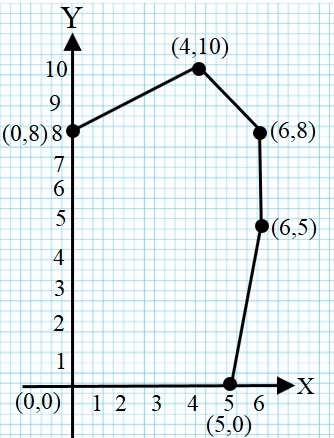
The feasible region for an $\text{LPP}$ is shown below:

Let $Z = 3x - 4y$ be the objective function. Minimum of $Z$ occurs at
The shortest distance between the lines ${r_1} = 4i - 3j - k + \lambda (i - 4j + 7k)$ and ${r_2} = i - j - 10k + \lambda (2i - 3j + 8k)$ is