MCQ
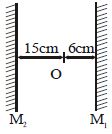
The position of $4^{th}$ image right to mirror $M_1$ is
  • A
    $69\,cm$ from $M_1$
  • B
    $48\,cm$ from $M_1$
  • $78\,cm$ from $M_1$
  • D
    $57\,cm$ from $M_1$

Answer

Correct option: C.
$78\,cm$ from $M_1$
c
${M_2}$ ${M_1}$
$15$ $6$
$27$ $36$
$57$ $48$
  $78$

$78\,cm$ from ${M_1}$

Need a full question paper?

Generate a complete, print-ready paper with questions like this in minutes — across 16+ boards, with answer keys.
Start Generating Free

Similar questions

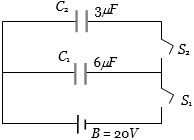
In the circuit shown here ${C_1} = 6\,\mu F,\;{C_2} = 3\,\mu F$ and battery $B = 20\,V$. The switch ${S_1}$ is first closed. It is then opened and afterwards ${S_2}$ is closed. What is the charge finally on ${C_2}$.......$\mu C$
An infinite line charge is at the axis of a cylinder of length $1 \,m$ and radius $7 \,cm$. If electric field at any point on the curved surface of cylinder is $250 \,NC ^{-1}$, then net electric flux through the cylinder is ............ $Nm ^2 C ^{-1}$
Three charge $q$, $Q$ and $4q$ are placed in a straight line of length $l$ at points distant $0,\,\frac {l}{2}$ and $l$ respectively from one end. In order to make the net froce on $q$ zero, the charge $Q$ must be equal to
In a triode amplifier, the value of maximum gain is equal to
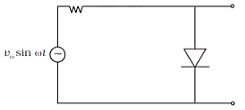
The output of the given circuit in Figure.
Image
In an ac circuit, $V$ and $I$ are given by $V = 150\,sin\,(150t)\,V$ and $I = 150\,\sin \,\left( {150t + \frac{\pi }{3}} \right)A$. The power dissipated in the circuit is.......$W$
If the voltage of $X-$ ray tube is doubled, the intensity of $ X-$ rays will become
A radioactive nuclide is produced at the constant rate of $n$ per second (say, by bombarding a target with neutrons). The expected number $N$ of nuclei in existence $t\, seconds$ after the number is $N_0$ is given by Where $\lambda $ is the decay constant of the sample
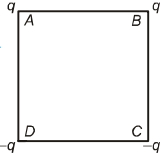
Charges are placed on the vertices of a square as shown Let $\vec E$ be the electric field and $V$ the potential at the centre. If the charges on $A$ and $B$ are interchanged with those on $D$ and $C$ respectively, then
A glass prism has a right-triangular cross-section $A B C$, with $\angle A=90^{\circ}$. A ray of light parallel to the hypotenuse $B C$ and incident on the side $A B$ emerges grazing the side $A C$. Another ray, again parallel to the hypotenuse $B C$, incident on the side $A C$ suffers total internal reflection at the side $A B$. Which one of the following must be true about the refractive index $\mu$ of the material of the prism?