Question
The position of a particle is given by $\text{r}=3.0\text{t}\hat{\text{i}}-2.0\text{t}^2\hat{\text{j}}+4.0\hat{\text{k }}\text{m}$ Where t is in seconds and the coefficients have the proper units for r to be in metres. (a) Find the v and a of the particle? (b) What is the magnitude and direction of velocity of the particle at t = 2.0s?
Answer

  1. $\vec{\nu}(\text{t})=(3.0\hat{\text{i}}-4.0\text{t}\hat{\text{J}});\text{a}=-4.0\hat{\text{j}}$
The position of the particle is given by:
$\vec{\text{r}}=3.0\text{t}\hat{\text{i}}-2.0\text{t}^2\hat{\text{J}}+4.0\hat{\text{k}}$
Velocity $\vec{\nu},$ of the particle given as:
$\vec{\nu}=\frac{\text{d}\vec{\text{r}}}{\text{dt}}=\frac{\text{d}}{\text{dt}}(3.0\text{t}\hat{\text{i}}-2.0\text{t}^2\hat{\text{J}}+4.0\hat{\text{k}})$
$\therefore\vec{\nu}=3.0\hat{\text{i}}-4.0\text{t}\hat{\text{J}}$
Acceleration, $\vec{\text{a}},$ of the particle is given as:
$\vec{\text{a}}=\frac{\text{d}\vec{\nu}}{\text{dt}}=\frac{\text{d}}{\text{dt}}(3.0\hat{\text{i}}-4.0\text{t}\hat{\text{J}})$
$\therefore\vec{\text{a}}=-4.0\hat{\text{J}}$
  1. 8.54m/s, 69.45° below the x - axis
We have velocity vector, $\vec{\nu}=3.0\hat{\text{i}}-4.0\text{t}\hat{\text{J}}$
$\text{At t}=2.0\text{s}:$
$\vec{\nu}=3.0\hat{\text{i}}-8.0\hat{\text{J}}$
The magnitude of veocity is given by:
$|\vec{\nu}|\sqrt{3^2+(-8)^2}=\sqrt{73}=8.54\text{m/s}$
Direction, $\theta=\tan^{-1}\Big(\frac{\nu_\text{y}}{\nu_\text{x}}\Big)$
$=\tan^{-1}\Big(\frac{-8}{3}\Big)=-\tan^{-1}(2.667)$
$=-69.45^\circ$
The negative sing indicates that the direction of velocity is below the x - axis.

Need a full question paper?

Generate a complete, print-ready paper with questions like this in minutes — across 16+ boards, with answer keys.

Start Generating Free

Similar questions

A hot body placed in a surrounding of temperature $\theta_0$ obeys Newton's law of cooling $\frac{\text{d}\theta}{\text{dt}}=-\text{k}(\theta-\theta_0).$ Its temperature at $t = 0$ is $\theta_1.$ The specific heat capacity of the body is s and its mass is m. Find,
  1. The maximum heat that the body can lose.
  2. The time starting from $t = 0$ in which it will lose $90\%$ of this maximum heat.
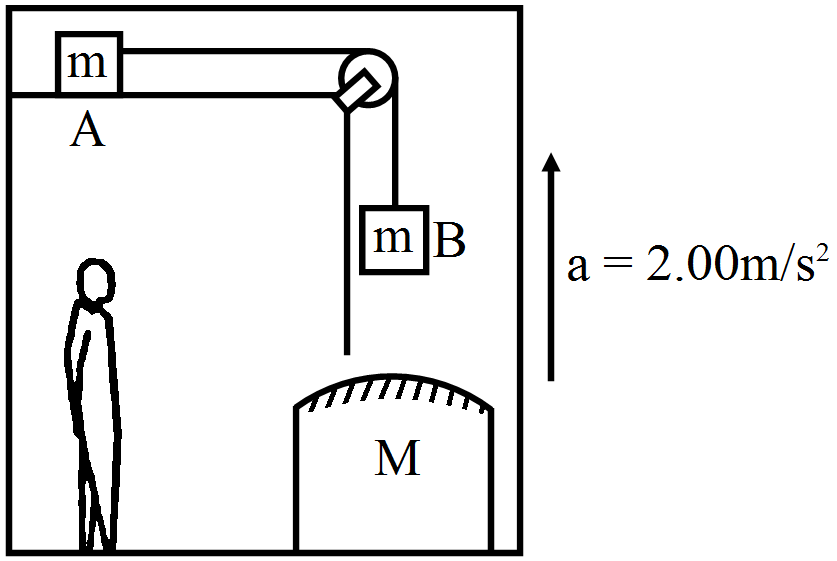
Consider the situation shown in figure. The elevator is going up with an acceleration of $2.00m/s^2$ and the focal length of the mirror is 12.0cm. All the surfaces are smooth and the pulley is light. The mass-pulley system is released from rest (with respect to the elevator) at t = 0 when the distance of B from the mirror is $42.0cm$. Find the distance between the image of the block B and the mirror at $t = 0.200s$. Take $g = 10m/s^2$.
No physicist has ever “seen” an electron. Yet, all physicists believe in the existence of electrons. An intelligent but superstitious man advances this analogy to argue that ‘ghosts’ exist even though no one has ‘seen’ one. How will you refute his argument?
A proton projected in a magnetic field of $0.020T$ travels along a helical path of radius $5.0cm$ and pitch $20cm$. Find the components of the velocity of the proton along and perpendicular to the magnetic field. Take the mass of the proton = $1.6 \times 10^{-27}kg$
  1. It is known that density r of air decreases with height y as $\rho_0\text{e}^{-\frac{\text{y}}{\text{y}_0}}$ where $\rho=1.25\text{kg m}^{-3}$ is the density at sea level, and $y_0$ is a constant. This density variation is called the law of atmospheres. Obtain this law assuming that the temperature of atmosphere remains a constant (isothermal conditions). Also assume that the value of g remains constant.
  2. A large He balloon of volume $1425m^3$ is used to lift a payload of 400kg. Assume that the balloon maintains constant radius as it rises. How high does it rise? [Take $y^0 = 8000m$ and $rHe = 0.18 kgm^{–3}​​​​​​​$].
Suppose the $19\Omega$ resistor of the previous problem is disconnected. Find the current through $P_2Q_2$ in the two situations:
  1. Both the wires move towards right.
  2. If $P_1Q_1$ moves towards left but $P_2Q_2$ moves towards right.
A shell of mass $0.020kg$ is fired by a gun of mass $100kg$. If the muzzle speed of the shell is $80ms^{-1}$, what is the recoil speed of the gun?
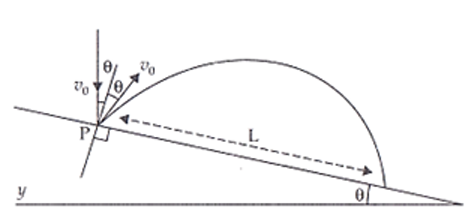
A particle falling vertically from a height hits a plane surface inclined to horizontal at an angle with speed $v_0$ and rebounds elastically as shown in the figure. Find the distance along the plane where it will hit the second time.
Image
Hint:
i. After rebound, particle still has speed $V_0$ to start.
ii. Work out angle particle speed has with horizontal after it rebounds.
iii. Rest is similar to if particle is projected up the incline.]
A $2kg$ body and a $3kg$ body are moving along the x-axis. At a particular instant, the $2kg$ body is $1m$ from the origin and has a velocity of $3ms^{-1}$ and the $3kg$ body is $2m$ from the origin and has velocity of $-1 ms^{-1}$. Find the position and velocity of the centre of mass and also find the total momentum.
Through what potential difference should an electron be accelerated to give it a speed of:
  1. 0.6c
  2. 0.9c
  3. 0.99c