Question
Through what potential difference should an electron be accelerated to give it a speed of:
  1. 0.6c
  2. 0.9c
  3. 0.99c

Answer

  1. $\text{eV}-\text{m}_0\text{C}^2=\frac{\text{m}_0\text{C}^2}{2\sqrt{1-\frac{\text{V}^2}{\text{C}^2}}}$
$\Rightarrow\text{eV}-9.1\times10^{-31}\times9\times10^{16}$

$=-\frac{9.1\times9\times10^{-31}\times10^{16}}{2\sqrt{1-\frac{0.36\text{C}^2}{\text{C}^2}}}$

$\Rightarrow\text{eV}-9.1\times9\times10^{-15}$

$=\frac{9.1\times9\times10^{-15}}{2\times0.08}$

$\Rightarrow\text{ev}-9.1\times9\times10^{-15}$

$=\frac{9.1\times9\times10^{-15}}{1.6}$

$\Rightarrow\text{eV}=\Big(\frac{9.1\times9}{1.6}+9.1\times9\Big)\times10^{-15}$

$=\text{eV}\Big(\frac{81.9}{1.6}+81.9\Big)\times10^{-15}$

$=\text{eV}=133.0875\times10^{-15}$

$\Rightarrow\text{V}=83.179\times10^{4}=831\text{KV}$
  1. $\text{eV}=\text{m}_0\text{C}^2=\frac{\text{m}_0\text{C}^2}{2\sqrt{1-\frac{\text{V}^2}{\text{C}^2}}}$
$\Rightarrow\text{eV}-9.1\times9\times10^{-19}\times9\times10^{16}$

$=\frac{9.1\times9\times10^{-15}}{2\sqrt{1-\frac{0.81\text{C}^2}{\text{C}^2}}}$

$\Rightarrow\text{eV}-81.9\times10^{-15}=\frac{9.1\times9\times10^{-15}}{2\times0.435}$

$\Rightarrow\text{eV}=12.237\times10^{-15}$

$\Rightarrow\text{V}=\frac{12.237\times10^{-15}}{1.6\times10^{-19}}=76.48\text{kV}$

$\text{V}=0.99\text{C}=\text{ev}-\text{m}_0\text{C}^2=\frac{\text{m}_0\text{C}^2}{2\sqrt{1-\frac{\text{V}^2}{\text{C}^2}}}$

$\Rightarrow\text{eV}=\frac{\text{m}_0\text{C}^2}{2\sqrt{1-\frac{\text{V}^2}{\text{C}^2}}}+\text{m}_0\text{C}^2$

$=\frac{9.1\times10^{31}\times9\times10^{16}}{2\sqrt{1-(0.99)^2}} +9.1\times10^{-31}\times9\times10^{16}$

$\Rightarrow\text{eV}=372.18\times10^{-15}$

$\Rightarrow\text{V}=\frac{372.18\times20^{-15}}{1.6\times10^{-19}}=272.6\times10^{4}$

$\Rightarrow\text{V}=2.726\times10^{6}=2.7\text{MeV}$

Need a full question paper?

Generate a complete, print-ready paper with questions like this in minutes — across 16+ boards, with answer keys.
Start Generating Free

Similar questions

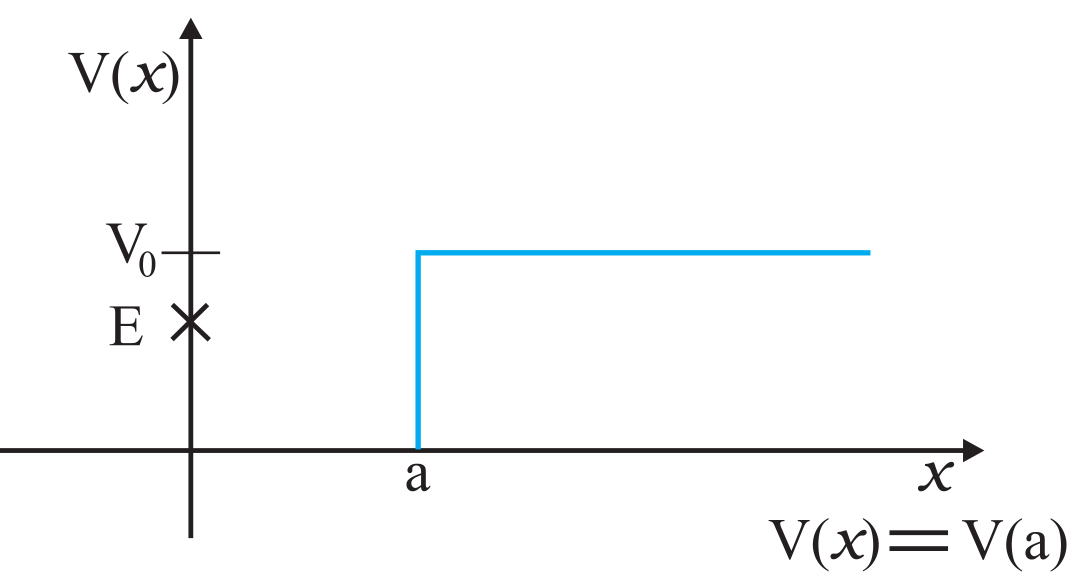
Given in are examples of some potential energy functions in one dimension. The total energy of the particle is indicated by a cross on the ordinate axis. In each case, specify the regions, if any, in which the particle cannot be found for the given energy. Also, indicate the minimum total energy the particle must have in each case. Think of simple physical contexts for which these potential energy shapes are relevan.
The difference in the frequencies of series limit of Lyman series and Balmer series is equal to the frequency of the first line of the Lyman series. Explain.
A $100\mu\text{F}$ capacitor is joined to a 24V battery through a $1.0\text{M}\Omega$ resistor. Plot qualitative graphs (a) between current and time for the first 10 minutes and (b) between charge and time for the same period.
An ideal gas is kept in a long cylindrical vessel fitted with a frictionless piston of cross-sectional area $10cm^2$ and weight $1kg$. The length of the gas column in the vessel is $20cm$. The atmospheric pressure is $100kPa$. The vessel is now taken into a spaceship revolving round the earth as a satellite. The air pressure in the spaceship is maintained at $100kPa$. Find the length of the gas column in the cylinder.
Define gravitational potential. Derive the formulas of gravitional potential due to a solid sphere of mass M and radius R at points located on its outer surface and inside.
A simple harmonic wave is expressed by equation:
$\text{y}=7\times10^{-6}\sin\Big(800\pi\text{t}-\frac{\pi}{42.5}\text{x}\Big)$
where y and x are in cm. and t in seconds. Calculate the following:
  1. Amplitude.
  2. Frequency.
  3. Wavelength.
  4. Wave velocity.
  5. Phase difference between two particles separated by 17.0cm.
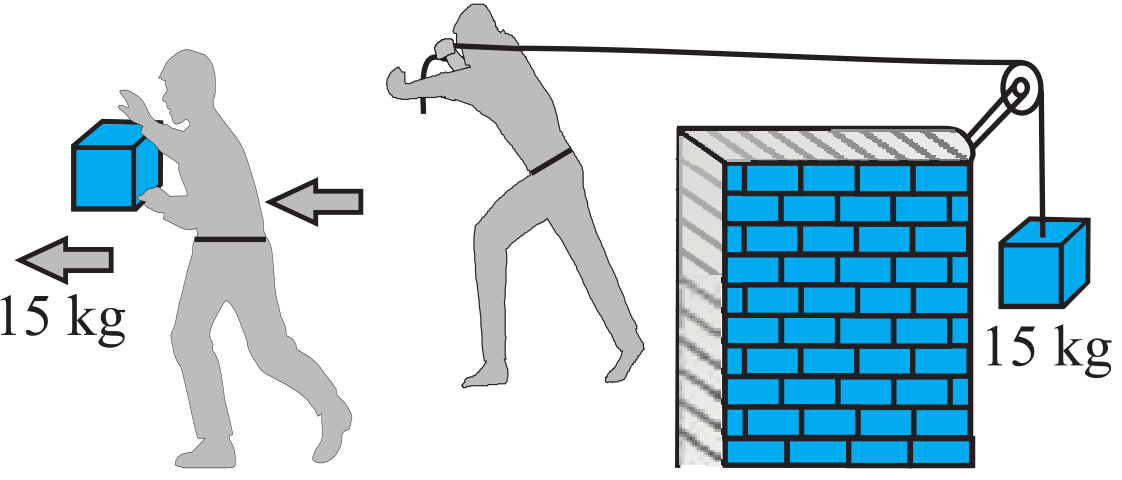
Answer the following: In the man walks $2m$ carrying a mass of $15kg$ on his hands. In he walks the same distance pulling the rope behind him. The rope goes over a pulley, and a mass of $15kg$ hangs at its other end. In which case is the work done greater?
What are waves and wave speed? For wave propagation. What are the essential properties? How many types of waves are there? Explain by giving examples.
Calculate the frequency of beats produced in air when two sources of sound are activated, one emitting a wavelength of 32cm and the other of 32.2cm. The speed of sound in air is 350m/s.
A solid sphere rolls down two different inclined planes of the same heights but different angles of inclination.
  1. Will it reach the bottom with the same speed in each case?
  2. Will it take longer to roll down one plane than the other?
  3. If so, which one and why?