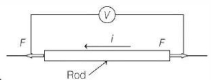
The positive temperature coefficient of resistance is for
Easy
Download our app for free and get started
(c) For metallic conductors, temperature co-efficient of resistance is positive.

Download our appand get started for free
Experience the future of education. Simply download our apps or reach out to us for more information. Let's shape the future of learning together!No signup needed.*
Similar Questions
- 1A cable of resistance $10\,\Omega $ carries electric power from a generator producing $250\, kW$ at $10000\, volt$. The current in the cable is ............. $A$View Solution
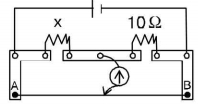
- 2A meter bridge is set up as shown, to determine an unknown resistance ' $X$ ' using a standard $10\,ohm$ resistor. The galvanometer shows null point when tapping-key is at $52\,cm$ mark. The endcorrections are $1\,cm$ and $2\,cm$ respectively for the ends $A$ and $B$. The determined value of ' $X$ ' is $..........\Omega$View Solution
- 3A cell of negligible resistance and $e.m.f.$ $2$ $volts$ is connected to series combination of $2$, $3$ and $5\, ohm$. The potential difference in volts between the terminals of $3\, ohm$ resistance will beView Solution
- 4Two indentical electric lamps marked $500\, W, \,\,220\, V$ are connected in series and then joined to a $110\, V$ line. The power consumed by each lamp isView Solution
- 5The number of dry cells, each of $e.m.f.$ $1.5\,volt$ and internal resistance $0.5\, ohm$ that must be joined in series with a resistance of $20\, ohm$ so as to send a current of $0.6\,A$ through the circuit isView Solution
- 6A potentiometer wire of length $100\, cm$ has a resistance of $10\, ohm.$ It is connected in series with a resistance and an accumulator of emf $2\,V$ and of negligible internal resistance. A source of emf $10\, mV$ is balanced against a length of $40\, cm$ of the potentiometer wire. What is the value of external resistance :- ................. $\Omega$View Solution
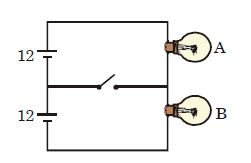
- 7Two light bulbs in the circuit have rating $A\,[24\ V, 48\,W]$ and $B\,[24\ V, 36\,W]$ as shown.View Solution
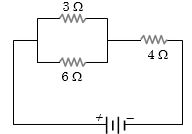
- 8In the figure, current through the $3\,\Omega $ resistor is $0.8\, ampere$, then potential drop through $4\,\Omega $ resistor is ........... $V$View Solution
- 9The current through a wire depends on time as $i = (2+3t)\, mA$. The charge crossing through a section of the wire in $1\, min$ is .............. $\mathrm{C}$View Solution
- 10As shown in the schematic below, a rod of uniform cross-sectional area $A$ and length $l$ is carrying a constant current $i$ through it and voltage across the rod is measured using an ideal voltmeter. The rod is stretched by the application of a force $F$. Which of the following graphs would show the variation in the voltage across the rod as function of the strain $\varepsilon$ when the strain is small. Neglect Joule heating.View Solution