MCQ
The positive temperature coefficient of resistance is for
  • A
    Carbon
  • B
    Germanium
  • Copper
  • D
    An electrolyte

Answer

Correct option: C.
Copper
c
(c) For metallic conductors, temperature co-efficient of resistance is positive.

Need a full question paper?

Generate a complete, print-ready paper with questions like this in minutes — across 16+ boards, with answer keys.

Start Generating Free

Similar questions

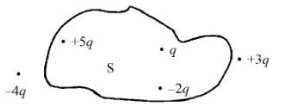
Five charges $+q,+5 q,-2 q,+3 q$ and $-4 q$ are situated as shown in the figure.

The electric flux due to this configuration through the surface $S$ is
The region of the atmosphere above troposphere is known as
A parallel plate capacitor Air filled with a dielectric whose dielectric constant varies with applied voltage as $K = V$. An identical capacitor $B$ of capacitance $C_0$ with air as dielectric is connected to voltage source $V_0 = 30\,V$ and then connected to the first capacitor after disconnecting the voltage source. The charge and voltage on capacitor.
Various optical processes are involved in the formation of a rainbow. Which of the following provides the correct order in time in which these processes occur?
When a photon stimulates the emission of another photon, the two photons have:
Two short bar magnets of magnetic moments $m$ each are arranged at the opposite corners of a square of side $d$ such that their centres coincide with the corners and their axes are parallel. If the like poles are in the same direction, the magnetic induction at any of the other corners of the square is
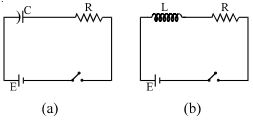
The switches in figures $(a)$ and $(b)$ are closed at $t = 0$
By what percentage will the illumination of the lamp decrease if the current drops by $20 \%$ ?
Two voltameters, one of copper and another of silver, are joined in parallel. When a total charge q flows through the voltameters, equal amount of metals are deposited. If the electrochemical equivalents of copper and silver are $z_1$ and $z_2$ respectively the charge which flows through the silver voltameter is
A nucleus ruptures into two nuclear parts which have their velocity ratio equal to $2: 1$. What will be the ratio of their nuclear size (nuclear radius)