Question
The positive temperature coefficient of resistance is for(a) Carbon(b) Germanium(c) Copper(d) An electrolyte
       

Answer

(c) Copper

Need a full question paper?

Generate a complete, print-ready paper with questions like this in minutes — across 16+ boards, with answer keys.

Start Generating Free

Similar questions

Demagnetisation of magnets can be done by(a) Rough handling(b) Heating(c) Magnetising in the opposite direction(d) All the above
   
   
Assertion : The induced e.m.f. and current will be same in two identical loops of copper and aluminium, when rotated with same speed in the same magnetic field.
Reason : Induced e.m.f. is proportional to rate of change of magnetic field while induced current depends on resistance of wire.
The north pole of a long horizontal bar magnet is being brought closer to a vertical conducting plane along the perpendicular direction. The direction of the induced current in the conducting plane will be(a) Horizontal(b) Vertical(c) Clockwise(d) Anticlockwise
       
There is a small hole near the bottom of an open tank filled with a liquid. The speed of the water ejected does not depend on.
  1. Area of the hole.
  2. Density of the liquid.
  3. Height of the liquid from the hole.
  4. Acceleration due to gravity.
Two non-ideal batteries are connected in parallel. Consider the following statements:
  1. The equivalent emf is smaller than either of the two emfs.
  2. The equivalent internal resistance is smaller than either of the two internal resistances.
If the shift of wavelength of light emitted by a star is towards violet, then this shows that star is(a) Stationary(b) Moving towards earth(c) Moving away from earth(d) Information is incomplete
   
   
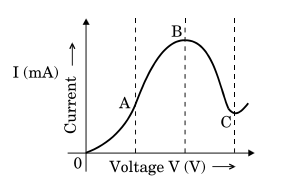
Identify the type of conductor represented by the V-I characteristic curve given below.
Image
The angular momentum of an electron in an orbit is quantized because it is a necessary condition for the compatibility with:
For a material, the refractive indices for red, violet and yellow colour light are respectively 1.52, 1.64 and 1.60. The dispersive power of the material is(a) 2  (b) 0.45(c) 0.2(d) 0.045
       
The angle which subtends the periphery of the spherical mirror at the centre of curvature is called: