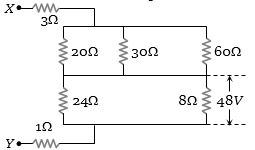
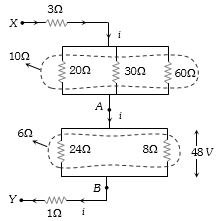
The potential difference across $8\, ohm$ resistance is $48\, volt$ as shown in the figure. The value of potential difference across $X$ and $Y$ points will be ............. $volt$
Diffcult


Download our appand get started for free
Experience the future of education. Simply download our apps or reach out to us for more information. Let's shape the future of learning together!No signup needed.*
Similar Questions
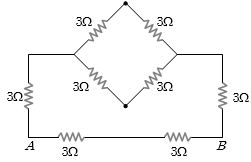
- 1Equivalent resistance between $A$ and $B$ will be ............ $ohm$View Solution
- 2A potential difference of $10 \,V$ is applied across a conductor of $1000 \,\Omega$. The number of electrons flowing through the conductor in $300 \,s$ is ..........View Solution
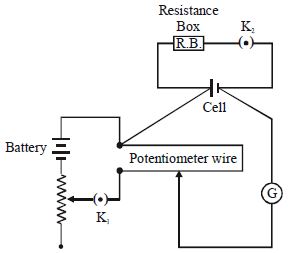
- 3The adjoining figure shows the connections of potentiometer experiment to determine internal resistance of of a leclanche cell. When the cell is on open circuit the balancing length of the potentiometer wire is $3.4\, m$ and on closing the key $K_2$ the balancing length becomes $1.7\, m$ . If the resistance $R$ through which current is drawn is $10\,\Omega $ then the internal resistance of the cell is .............. $\Omega$View Solution
- 4A metal wire has a resistance of $35 \,\Omega$. If its length is increased to double by drawing it, then its new resistance will be (in $\Omega$)View Solution
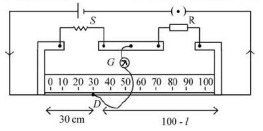
- 5In meter bridge experiment for measuring unknown resistance ' $S$ ', the null point is obtained at a distance $30 cm$ from the left side as shown at point $D$. If $R$ is $5.6 k \Omega$, then the value of unknown resistance ' $S$ ' will be $\Omega .$View Solution
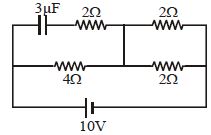
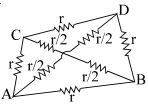
- 6The figure shows a tetrahedron, each side of which has a resistance $r$ If a battery is connected between any two points of the tetrahedron, then identify the correct statement $(s)$.View Solution
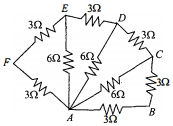
- 7Six resistors of $3 \;\Omega$ each are connected along the sides of a hexagon and three resistors of $6\; \Omega$ each are connected along $A C, A D$ and $A E$ as shown in the figure. The equivalent resistance between $A$ and $B$ is equal toView Solution
- 8An infinite line charge of uniform electric charge density i. lies along the axis of an electrically conducting infinite cylindrical shell of radius $R$. At time $t=0$, the space inside the cylinder is filled with a material of permittivity $\varepsilon$ and electrical conductivity $\sigma$. The electrical conduction in the material follows Ohm's law. Which one of the following graphs best describes the subsequent variation of the magnitude of current censity $j(t)$ at any point in the material?View Solution
- 9You are given a resistance wire of length $50\, cm$ and a battery of negligible resistance. In which of the following cases is largest amount of heat generatedView Solution
- 10Find charge stored on the capacitor in steady state condition .............. $\mu C$View Solution