A potential difference of $10 \,V$ is applied across a conductor of $1000 \,\Omega$. The number of electrons flowing through the conductor in $300 \,s$ is ..........
Easy


Download our appand get started for free
Experience the future of education. Simply download our apps or reach out to us for more information. Let's shape the future of learning together!No signup needed.*
Similar Questions
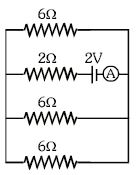
- 1The ammeter reading in the following circuit will be .............. $A$View Solution
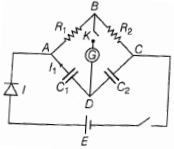
- 2ln the circuit in the figure, if no current flows through the galvanometer when the key $K$ is closed, the bridge is balanced. The balancing condition for bridge isView Solution
- 3In an electric heater $4\, amp$ current passes for $1$ minute at potential difference of $250\, volt$, the power of heater and energy consumed will be respectivelyView Solution
- 4An electric iron draws $5\, amp$, a $TV$ set draws $3\, amp$ and refrigerator draws $2\, amp$ from a $220\, volt$ main line. The three appliances are connected in parallel. If all the three are operating at the same time, the fuse used may be of ............. $amp$View Solution
- 5A copper wire of length $1\, m$ and radius $1\, mm$ is joined in series with an iron wire of length $2\, m$ and radius $3\, mm$ and a current is passed through the wires. The ratio of the current density in the copper and iron wires isView Solution
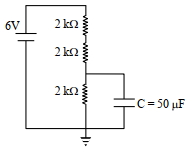
- 6A capacitor of $50 \,\mu {F}$ is connected in a circuit as shown in figure. The charge on the upper plate of the capacitor is $......\,\mu {C} .$View Solution
- 7The $V-i$ graph for a conductor makes an angle $\theta $ with $V-$ axis. Here $ V$ denotes the voltage and $i$ denotes current. The resistance of conductor is given byView Solution
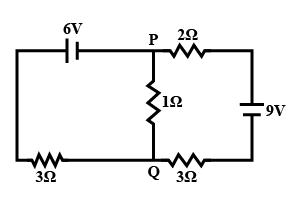
- 8In the circuit shown, the current in the $1\,\Omega$ resistor isView Solution
- 9A $10\, V$ storage battery of negligible internal resistance is connected across a $50\,\Omega $ resistor. How much heat energy is produced in the resistor in $1$ hour ............... $J$View Solution
- 10A piece of copper and another of germanium are cooled from room temperature to $80\, K$. The resistance of :-View Solution