Question
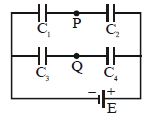
The potential difference between the points $P$ and $Q$ in the adjoining circuit will be :-
Answer

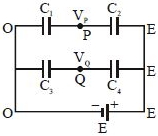
$\mathrm{C}_{1}$ and $\mathrm{C}_{2}$ are in series, charge on each will remain same.

$\left(\mathrm{V}_{\mathrm{P}}-\mathrm{O}\right) \cdot \mathrm{C}_{1}=\left(\mathrm{E}-\mathrm{V}_{\mathrm{P}}\right) \mathrm{C}_{2}$

$\mathrm{V}_{\mathrm{P}}=\frac{\mathrm{C}_{2} \mathrm{E}}{\mathrm{C}_{1}+\mathrm{C}_{2}}$

$\mathrm{C}_{3} $ and $ \mathrm{C}_{4}$ are in series,

charge on each will remain same,

$\left(\mathrm{V}_{\mathrm{Q}}-\mathrm{0}\right) \cdot \mathrm{C}_{3}=\left(\mathrm{E}-\mathrm{V}_{\mathrm{Q}}\right) \mathrm{C}_{4}$

$\mathrm{V}_{\mathrm{Q}}=\frac{\mathrm{C}_{4} \mathrm{E}}{\mathrm{C}_{3}+\mathrm{C}_{4}}$

Hence $\mathrm{V}_{\mathrm{P}}-\mathrm{V}_{\mathrm{Q}}=\frac{\left(\mathrm{C}_{2} \mathrm{C}_{3}-\mathrm{C}_{1} \mathrm{C}_{4}\right) \mathrm{E}}{\left(\mathrm{C}_{1}+\mathrm{C}_{2}\right)\left(\mathrm{C}_{3}+\mathrm{C}_{4}\right)}$
Need a full question paper?

Generate a complete, print-ready paper with questions like this in minutes — across 16+ boards, with answer keys.
Start Generating Free

Similar questions

The initial speed of a projectile fired from ground is $u$. At the highest point during its motion, the speed of projectile is $\frac{\sqrt{3}}{2} u$. The time of flight of the projectile is:
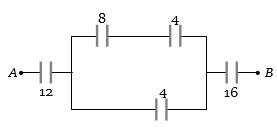
What is the equivalent capacitance between $A$ and $B$ in the given figure (all are in farad)
The gravitational force on a body of mass $1.5 \,kg$ situated at a point is $45 \,N$. The gravitational field intensity at that point is ......... $N / kg$
The intensity of sound wave while passing through an elastic medium falls down by $10\%$ as it covers one metre distance through the medium. If the initial intensity of the sound wave was $100$ decibels, its value after it has passed through $3$ metre thickness of the medium will be .... $decibel$
Consider a cube of uniform charge density $\rho$. The ratio of electrostatic potential at the centre of the cube to that at one of the corners of the cube is
A body is rolling without slipping on a horizontal plane. If the rotational energy of the body is $40\%$ of the total kinetic energy, then the body might be 
The ratio of gravitational acceleration at height $3R$ to that at height $4R$ from the surface of the earth is : (where $R$ is the radius of the earth)
A heavenly body is receding from earth such that the fractional change in $\lambda$ is $1$ , then its velocity is
A cylindrical vessel filled with water upto height of $H$ stands on a horizontal plane. The side wall of the vessel has a plugged circular hole touching the bottom. The coefficient of friction between the bottom of vessel and plane is $\mu$ and total mass of water plus vessel is $M$. What should be minimum diameter of hole so that the vessel begins to move on the floor if plug is removed (here density of water is $\rho$ )
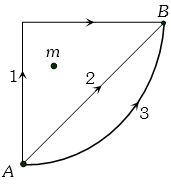
If ${W_1},\,{W_2}$ and ${W_3}$ represent the work done in moving a particle from $A$ to $B$ along three different paths $1, 2$ and $3$ respectively (as shown) in the gravitational field of a point mass m, find the correct relation between ${W_1},\,{W_2}$ and ${W_3}$