Question
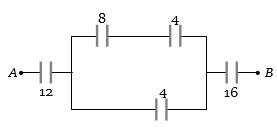
What is the equivalent capacitance between $A$ and $B$ in the given figure (all are in farad)
Answer

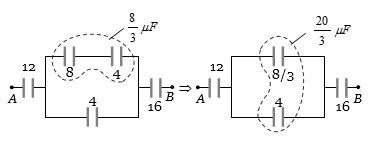
(d) The given circuit can be simplified as follows
Hence equivalent capacitance between $A$ and $B$
$\frac{1}{{{C_{AB}}}} = \frac{1}{{12}} + \frac{1}{{20/3}} + \frac{1}{{16}}$ $==>$ ${C_{AB}} = \frac{{240}}{{71}}\,F$

Need a full question paper?

Generate a complete, print-ready paper with questions like this in minutes — across 16+ boards, with answer keys.

Start Generating Free

Similar questions

An elevator weighing $6000\, kg$ is pulled upward by a cable with an acceleration of $5\,m{s^{ - 2}}$. Taking g to be $10\,m{s^{ - 2}}$, then the tension in the cable is ........... $N$
In charging a battery of motor-car, the following effect of electric current is used
Thickness of a pencil measured by using a screw gauge (least count $0.001 \,cm$ ) comes out to be $0.802 \,cm$. The percentage error in the measurement is ........... $\%$
$\alpha$ particle is revolving in radius $r$ with frequency $f$ then find value of magnetic dipole moment.
$Assertion$ : A tennis ball bounces higher on hills than in plains.
$Reason$ : Acceleration due to gravity on the hill is greater than that on the surface of earth
In electromagnetic theory, the electric and magnetic phenomena are related to each other. Therefore, the dimensions of electric and magnetic quantities must also be related to each other. In the questions below, $[E]$ and $[B]$ stand for dimensions of electric and magnetic fields respectively, while $\left[\varepsilon_0\right]$ and $\left[\mu_0\right]$ stand for dimensions of the permittivity and permeability of free space respectively. $[L]$ and $[T]$ are dimensions of length and time respectively. All the quantities are given in $SI$ units.

($1$) The relation between $[E]$ and $[B]$ is

$(A)$ $[ E ]=[ B ][ L ][ T ]$  $(B)$ $[ E ]=[ B ][ L ]^{-1}[ T ]$  $(C)$ $[ E ]=[ B ][ L ][ T ]^{-1}$  $(D)$ $[ E ]=[ B ][ L ]^{-1}[ T ]^{-1}$

($2$) The relation between $\left[\varepsilon_0\right]$ and $\left[\mu_0\right]$ is

$(A)$ $\left[\mu_0\right]=\left[\varepsilon_0\right][ L ]^2[ T ]^{-2}$  $(B)$ $\left[\mu_0\right]=\left[\varepsilon_0\right][ L ]^{-2}[ T ]^2$   $(C)$ $\left[\mu_0\right]=\left[\varepsilon_0\right]^{-1}[ L ]^2[ T ]^{-2}$  $(D)$ $\left[\mu_0\right]=\left[\varepsilon_0\right]^{-1}[ L ]^{-2}[ T ]^2$

Give the answer or quetion ($1$) and ($2$)
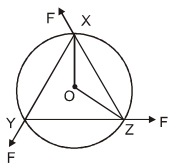
A uniform circular disc of mass $1.5 \ kg$ and radius $0.5 \ m$ is initially at rest on a horizontal frictionless surface. Three forces of equal magnitude $F=0.5 \ N$ are applied simultaneously along the three sides of an equilateral triangle $XYZ$ its vertices on the perimeter of the disc (see figure). One second after applying the forces, the angular speed of the disc in rad $s-1$ is:
At what temperature velocity of sound is double than that of at $0°C$
Which of the following is not due to total internal reflection? 
Infinite charges of magnitude $q$ each are lying at $x =1,\, 2,\, 4,\, 8...$ meter on $X$-axis. The value of intensity of electric field at point $x = 0$ due to these charges will be