The potential difference in open circuit for a cell is $2.2\, volts$. When a $4\, ohm$ resistor is connected between its two electrodes the potential difference becomes $2\, volts$. The internal resistance of the cell will be .............. $ohm$
Medium


Download our appand get started for free
Experience the future of education. Simply download our apps or reach out to us for more information. Let's shape the future of learning together!No signup needed.*
Similar Questions
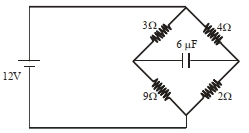
- 1In the circuit shown, the energy stored in the capacitor is $n\,\mu J$. The value of $n$ is ..............View Solution
- 2A certain piece of silver of given mass is to be made like a wire. Which of the following combination of length $(L)$ and the area of cross-sectional $(A) $ will lead to the smallest resistanceView Solution
- 3An unknown resistance $R_1$ is connected in series with a resistance of $10 \,\Omega$. This combinations is connected to one gap of a meter bridge while a resistance $R_2$ is connected in the other gap. The balance point is at $50\, cm$. Now, when the $10 \,\Omega$ resistance is removed the balance point shifts to $40\, cm$. The value of $R_1$ is (in $ohm$)View Solution
- 4A heating coil is labelled $100\, W$, $220\, V$. The coil is cut in half and the two pieces are joined in parallel to the same source. The energy now liberated per second is .............. $J$View Solution
- 5What will be the most suitable combination of three resistors $A =2\, \Omega, B =4\, \Omega, C =6\, \Omega$ so that $\left(\frac{22}{3}\right)\Omega$ is equivalent resistance of combination$?$View Solution
- 6The electric intensity $E$, current density $j$ and specific resistance $k$ are related to each other by the relationView Solution
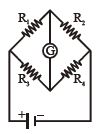
- 7The resistances in $WSB$ circuit shown in the diagram all are different and the current through the galvanometer is zero. If all thermal effects are negligible, the current through the galvanometer will not be zero, whenView Solution
- 8If the length of the filament of a heater is reduced by $10\%$, the power of the heater willView Solution
- 9In a large building, there are $15$ bulbs of $40\ W$, $5$ bulbs of $100\ W, 5$ fans of $80\ W$ and $1$ heater of $1\ kW$. The voltage of electric mains is $220\ V$. The minimum capacity of the main fuse of the building will be ................ $A$View Solution
- 10Two wires $A$ and $B$ are made up of the same material and have the same mass. Wire A has radius of $2.0 \mathrm{~mm}$ and wire $B$ has radius of $4.0 \mathrm{~mm}$. The resistance of wire B is $2 \Omega$. The resistance of wire $\mathrm{A}$ is_______. $\Omega$.View Solution